Boxelder Bugs & Fruit Flies

Two of the most searched nuisance pests in the U.S. — different problems, different solutions. Both are easy to control once you understand what's driving them.

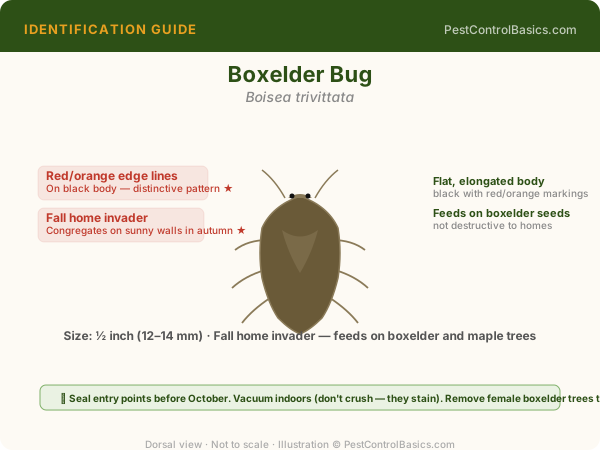
📐 FIELD GUIDE ILLUSTRATION
Boxelder Bug (Boisea trivittata) identification illustration with labeled anatomical features — PestControlBasics.com

Original illustration by PestControlBasics.com. Use anatomical labels above to confirm your identification.

🔍 Identification Photo

Use this photo to confirm your identification. Click to enlarge. Correct ID is the essential first step to effective treatment.

Boxelder bug (Boisea trivittata) — black with red wing outline forming X-pattern; overwinters in homes in large fall agg

Boxelder bug (Boisea trivittata) — black with red wing outline forming X-pattern; overwinters in homes in large fall aggregations

📷 Wikipedia / Wikimedia Commons / CC BY-SA

⚠️ Photo loaded live from Wikipedia/Wikimedia Commons (CC BY-SA). Appearance varies by region, age, and sex. When uncertain, contact a licensed pest professional.

Fall Invader Seal Before October Harmless to Humans
Boxelder Bug
Boisea trivittata
Like stink bugs, they invade homes every fall seeking warmth. Unlike stink bugs, they don't release an odor when crushed — but they do leave reddish stains on surfaces when squished. Seal in summer before they start looking.

Why They Invade Every Fall

Boxelder bugs spend spring and summer feeding on boxelder trees (also silver maple and ash) — consuming seeds, leaves, and plant juices. As temperatures drop in September and October, they migrate from their host trees toward warm structures for overwintering. They release aggregation pheromones that attract other boxelder bugs to the same overwintering sites, which is why the same homes are targeted year after year.

They enter through the same types of gaps as stink bugs: weatherstripping, window frames, utility penetrations, and siding gaps. Once inside walls, they cluster in large numbers and remain dormant until spring warmth triggers emergence — often reappearing inside the home on warm winter days near heat sources.

📅 The September Rule

All exclusion sealing must be complete before boxelder bugs begin migration — typically when nighttime temperatures first drop below 50°F, usually early-to-mid September. Sealing in October catches some but misses the early migrants. August through early September is the ideal window.

Control Strategy

Step 1 — Source reduction: If you have boxelder trees on your property, this is your primary driver. Female boxelder trees produce the seed pods they feed on. Removing female boxelder trees eliminates the food source. This isn't always practical but is the most permanent solution for chronic infestations.

Step 2 — Exclusion: Seal all weatherstripping, door sweeps, window frame gaps, utility penetrations, and soffit gaps before September. Same protocol as stink bug exclusion — these pests use the same entry points.

Step 3 — Exterior spray: Apply bifenthrin or permethrin to the south and west-facing walls of the structure in late September — these are the sun-warmed walls where boxelder bugs aggregate before entering. Kills bugs contacting the treated surface before they find entry points.

Indoor removal: Vacuum them up. Unlike stink bugs, squishing boxelder bugs doesn't release a strong pheromone — but they do leave reddish fecal stains on surfaces. Vacuum is cleaner. Do not use insecticide spray indoors — it doesn't address the population and contaminates living spaces unnecessarily.

💡 Dish Soap Spray — Direct Contact Kill

A solution of water and dish soap (2 tablespoons per quart) sprayed directly on aggregating boxelder bugs on sunny exterior walls kills them on contact by breaking down their breathing apparatus. Free, non-toxic, and highly effective for direct treatment of visible aggregations. Does not provide residual protection.

Do seal in summerSame entry points as stink bugs — weatherstripping, utility gaps, door sweeps. Complete by early September.
Don't spray indoorsInsecticide spray indoors doesn't solve the problem and isn't necessary. Vacuum instead.
Do treat sunny wallsBifenthrin on south/west-facing walls in late September kills aggregating bugs before entry.
Don't squish on fabricThey leave reddish stains when crushed. Use vacuum or physical removal on textiles.
Boxelder Bug — Quick Ref
Size1/2 inch
ColorBlack with red markings
Host TreeBoxelder, silver maple, ash
Invades WhenSeptember–October
Stinks?Mild odor — not like stink bugs
Stains?Yes — reddish fecal spots
Dangerous?No — harmless to humans
Seal DeadlineEarly September

🌿
Perimeter Spray
Bifenthrin — South/West Walls
Apply to sun-warmed exterior walls in late September where bugs aggregate before entering.
🪳
Breed in Overripe Fruit Eliminate Breeding Sites First 7-Day Lifecycle
Fruit Flies
Drosophila melanogaster — Common Fruit Fly
They seem to appear from nowhere — but they didn't. Every fruit fly infestation traces back to a specific breeding site. Find it and eliminate it, and the population collapses within a week. Spraying without finding the source just kills adults while larvae replenish the population.

Where They Come From — The Breeding Site Rule

Fruit flies don't spontaneously generate. They lay eggs in fermenting organic matter — and their larvae are so small they're invisible in most breeding sites. A single piece of overripe fruit, a wet mop head, organic buildup in a drain, a recycling bin with residue, or the drip tray under your refrigerator can sustain a population of thousands.

Female fruit flies can detect fermenting sugars from remarkable distances and through sealed spaces — they enter through window screens, open doors, and tiny cracks around windows. A single female lays up to 500 eggs in her lifetime, and egg-to-adult takes only 7 days at room temperature. This is why populations seem to explode overnight.

🔍 Find the Breeding Site — Everything Else Is Temporary

Fruit fly traps kill adults but don't stop the infestation if the breeding site persists. Larvae in the source continue hatching new adults indefinitely. The only permanent solution is finding and eliminating every breeding site. Common missed sources: recycling bins with residue, mop heads, overripe potatoes or onions in dark cabinets, garbage disposal buildup, and drains with organic film.

Finding Hidden Breeding Sites

Drain test: Place a piece of plastic wrap loosely over suspect drains at night. If fruit flies are breeding in the drain, you'll find them trapped under the plastic by morning. The drain P-trap and garbage disposal housing are common sites — clean with a drain brush and enzymatic drain cleaner (not bleach — bleach flushes past the buildup without cleaning it).

Follow the flies: Fruit flies don't travel far from their breeding site. Watch where they congregate — they'll cluster near the source within 1–3 feet. Check under appliances, in recycling bins, and in any area with standing moisture or organic residue.

The refrigerator drip tray: Pulled out and cleaned only once per blue moon, this tray collects moisture and organic debris and can sustain a fruit fly population for months. Pull it out and clean it thoroughly.

Treatment Protocol

Step 1: Remove all overripe fruit. Store fresh fruit in the refrigerator until infestation is resolved. Empty all trash and recycling — rinse bins thoroughly. Clean the garbage disposal with ice cubes and rock salt, then flush with boiling water.

Step 2: Pour enzymatic drain cleaner (like Invade Bio Drain) into all suspect drains. Let sit overnight. This digests the organic biofilm that fruit flies breed in — bleach doesn't accomplish this.

Step 3: Set ACV traps to capture remaining adults while the breeding site elimination takes effect. Population should drop dramatically within 5–7 days. If it doesn't, a breeding site remains undiscovered.

ACV trap recipeApple cider vinegar + drop of dish soap in a glass covered with plastic wrap (holes poked in). Flies enter and drown.
Don't use bleach on drainsBleach kills on contact but doesn't remove the organic film. Use enzymatic cleaner that digests buildup.
Check the recycling binResidue in rinsed bottles and cans is a major overlooked breeding site. Rinse thoroughly or keep outside.
Store fruit in refrigeratorDuring and after an infestation, keep all fruit refrigerated until population is zero for 7 consecutive days.
Fruit Fly — Quick Ref
Size1/8 inch — tiny
ColorTan/yellowish, red eyes
Lifecycle7 days egg to adult
Breeds InFermenting organic matter
Peak SeasonSummer/fall — warm weather
Control KeyEliminate breeding sites
Drain TestPlastic wrap overnight
Dangerous?No — nuisance only

🧪
Drain Cleaner
Invade Bio Drain (Enzymatic)
Digests organic biofilm in drains. Pour, let sit overnight. Far more effective than bleach for drain flies and fruit flies.
🧼
Trap
TERRO Fruit Fly Traps (or DIY ACV)
Captures adults while you eliminate breeding sites. Population drops within 5–7 days of source removal.
📚 Sources: EPA Termite Guide · NPMA Termite Info
Published: Jan 1, 2025 · Updated: Apr 7, 2026
Boxelder Bugs & Fruit Flies

Frequently Asked Questions

How do I know if I have Boxelder Bugs & Fruit Flies?

Signs of Boxelder Bugs & Fruit Flies include physical sightings, droppings or frass, damage to food or materials, and unusual odors. Inspect hidden areas like wall voids, behind appliances, and in storage spaces. A flashlight inspection after dark is often most revealing.

Are Boxelder Bugs & Fruit Flies dangerous to humans or pets?

Boxelder Bugs & Fruit Flies can pose health risks including bites, allergic reactions, food contamination, and disease transmission. Children, elderly, and pets are especially vulnerable. Consult a pest management professional when an infestation is confirmed.

Can I eliminate Boxelder Bugs & Fruit Flies myself?

Light infestations may be manageable with DIY baits, traps, and targeted treatments. Established infestations typically require professional intervention. Misapplied products often scatter pests and worsen the problem long-term.

How long does Boxelder Bugs & Fruit Flies treatment take?

Timelines vary by infestation size and method. Baits may take 1–4 weeks to work through a colony. Chemical treatments often require 2–3 applications spaced 2–4 weeks apart. Monitor for 30–60 days after treatment to confirm elimination.

What attracts Boxelder Bugs & Fruit Flies to my home?

Boxelder Bugs & Fruit Flies are typically drawn by food sources, standing moisture, warmth, and shelter. Sealing entry points, reducing clutter, fixing leaks, and storing food in airtight containers are the most effective long-term prevention measures.

Related Resources

📚 Full Pest Library🧪 DIY vs. Pro Quiz💰 Cost Guide🌿 IPM Guide🔍 Find a Pro
🧪 Recommended Treatment Products
Bifenthrin Lambda-Cyhalothrin IPM Guide Pyrethrin Aerosol Bti (Drain/Fungus Gnats)
Full product guides with mixing rates and safety info. → Browse All 130 Pesticide Guides
🔮
Reviewed by Derek GiordanoContent on PestControlBasics.com is developed with input from certified pest management professionals and cross-referenced against EPA, CDC, and university extension guidance. Last reviewed: April 2026.

🗺️ US Distribution — Boxelder Bugs & Fruit Flies

image/svg+xml
Common Occasional Not Present
States Present
49
Occasional
2
Primary Region
Continental US
📊 Source: University extension services, USDA, CDC vector data, and published entomological surveys.