⚠️ High Risk 🌎 Invasive Species 📍 Southeast, Southwest, Sun Belt

Red Imported
Fire Ant

Solenopsis invicta

One of North America's most aggressive invasive species — not native to the U.S., brought from South America, and now impossible to fully eradicate. But you can control them.

📏
Size1/8 – 1/4 inch
👑
Colony SizeUp to 500,000
🌡️
Peak SeasonSpring & Fall
🌍
OriginSouth America
💀
DangerVenom / Anaphylaxis
🐜
Quick Reference Card
Red Imported Fire Ant
ColorReddish-brown, darker abdomen
ShapeSegmented, 6 legs, elbowed antennae
MoundDome-shaped, no visible entry hole
StingYes — painful, pustule forms after
Active WhenDaytime, 65–90°F soil temps
Nests InOpen lawns, disturbed soil, fields
Risk LevelHIGH — Anaphylaxis Possible
DIY-able?Yes, with proper product & timing
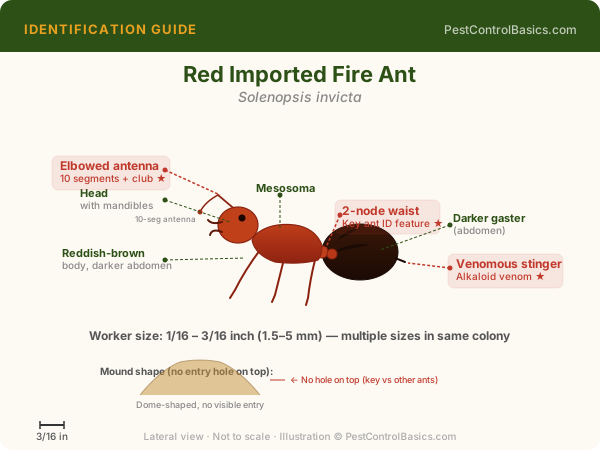
📐 FIELD GUIDE ILLUSTRATION
Red imported fire ant (Solenopsis invicta) identification illustration with labeled anatomical features — PestControlBasics.com

Original illustration by PestControlBasics.com. Use anatomical labels above to confirm your identification. For photo references, see the identification section below.

🔍 Identification Photo

Use this photo to confirm your identification. Click to enlarge.

Red imported fire ant (Solenopsis invicta) — reddish-brown workers 2–6mm; dome mound with no visible opening on top is t

Red imported fire ant (Solenopsis invicta) — reddish-brown workers 2–6mm; dome mound with no visible opening on top is the definitive sign

📷 Wikipedia / Wikimedia Commons / CC BY-SA

⚠️ Photo loaded live from Wikipedia/Wikimedia Commons (CC BY-SA).

⚠️ Photos loaded from Wikipedia/Wikimedia Commons. Appearance varies by region, age, and sex.

Origin & History

They shouldn't be here. But they are.

The Red Imported Fire Ant (Solenopsis invicta) is not native to the United States. It originated in the wetlands of central South America — primarily Brazil, Argentina, and Paraguay — where natural predators, parasites, and competitors kept it in check.

The first documented U.S. arrival was in the 1930s through the Port of Mobile, Alabama, almost certainly via soil used as ballast in cargo ships. Without its natural enemies, the fire ant exploded across the American South, spreading at a rate of roughly 25 miles per year. By the 1950s, it had colonized most of the Southeast. Today it infests over 320 million acres across 14 southern states and Puerto Rico.

🚢 How It Traveled

Cargo ships arriving from South America used soil and sand as ballast weight. When that ballast was dumped at port, fire ants — eggs, larvae, queens and all — came with it. A single mound can contain multiple queens, each capable of founding a new colony. Once the infestation started, it was essentially unstoppable.

The USDA spent billions attempting eradication in the 1950s–70s using pesticides like Mirex — which ultimately caused widespread environmental damage without eliminating the ant. Today the accepted strategy is not eradication, but control. Understanding this distinction will save you time, money, and frustration.

🗓️
1930s
First arrived in Mobile, Alabama via cargo ship ballast
🗺️
320M+
Acres currently infested across the southern U.S.
💰
$6B+
Annual economic cost in the U.S. — damage, control & medical
Identification Guide

How to know it's a fire ant — not just any ant

Many homeowners mistake other ants for fire ants. The wrong identification leads to the wrong treatment. Here's exactly what to look for — both the ant itself and its telltale mound.

Body Color
Reddish-brown thorax, darker (nearly black) abdomen. Workers vary in size within the same colony.
The Mound
Dome-shaped, no visible entry hole on top. Entry tunnels are underground. Mounds can reach 18 inches tall after rain.
Behavior Test
Disturb the mound slightly — fire ants boil to the surface aggressively within seconds. Other ant species scatter or retreat.
The Sting
Fire ants sting, not bite. The sting causes immediate burning, then a white pustule forms within 24 hours. This is the giveaway.
Antennae
10-segmented, with a 2-segment club at the tip. Elbowed (like most ants, but the club is distinctive).
Location
Prefer open, sunny areas: lawns, fields, roadsides, golf courses. Avoid dense shade. Rarely seen inside structures.
⚠️ Allergy Warning

Roughly 1% of the U.S. population has a severe fire ant allergy. Anaphylaxis is possible within minutes of a sting. If someone is stung and shows signs of difficulty breathing, dizziness, or widespread hives, call 911 immediately. People with known insect allergies should carry an EpiPen and never treat fire ant mounds alone.

Habits & Behavior

What they do — and when

Understanding fire ant behavior is the key to effective control. You're not just killing ants — you need to reach and eliminate the queen. A colony without a queen dies within months. Killing workers alone accomplishes almost nothing.

Colony Structure

A mature fire ant colony contains 100,000 to 500,000 workers of different sizes (called polymorphic workers), a few hundred winged males, and one or more queens. The queen's only job is reproduction — she can lay up to 1,500 eggs per day and live for 6–7 years. Workers live only 5–6 weeks.

Swarming & Reproduction

Fire ants reproduce through "nuptial flights" — winged males and females leave the colony on warm, humid days (typically spring after a rain). After mating in the air, males die and fertilized females (future queens) land, shed their wings, and attempt to start new colonies. One successful queen can build a visible mound within months.

Flooding Behavior

This surprises most homeowners: fire ant colonies do not drown. During floods, fire ants link their bodies together to form a living raft — sometimes the size of a basketball — that floats until it reaches dry land. This is how they spread after hurricanes and heavy rains. Never approach floating fire ant masses in floodwater.

💡 Pro Tip: The Two-Step Method

The most effective DIY fire ant strategy is the "Two-Step Method" developed by Texas A&M AgriLife: (1) broadcast a bait product across the entire lawn in spring and fall, and (2) treat individual mounds with a contact insecticide. Bait reaches the queen; contact kills the workers. Together they're far more effective than either alone.

📅 Fire Ant Activity by Month (Southern U.S.)
Jan
Feb
Mar
Apr
May
Jun
Jul
Aug
Sep
Oct
Nov
Dec
Peak Activity — Treat Now
High Activity
Moderate / Low Activity
Treatment Guide

The right products — and how to use them

Most people grab a can of spray and drench the mound. That kills workers on the surface and drives the queen deeper — she's gone in hours, survivors rebuild within weeks, and you're back where you started. Here's what actually works.

🌾
Bait — Most Effective DIY Method
Ortho Orthene Fire Ant Killer / Amdro Fire Ant Bait
How it works: Workers pick up bait, carry it to the queen, she eats it and dies. The whole colony collapses within 1–2 weeks. Broadcast across lawn with a spreader. Do not water in. Do not disturb mounds for 48 hrs after application. Best applied in spring and fall when ants are actively foraging.
★★★★★
Excellent
💧
Contact Insecticide — Individual Mound Treatment
Spectracide Fire Ant Shield / Bifenthrin Granules
How it works: Apply directly to individual mounds. Bifenthrin granules are activated with water — pour 1–2 gallons gently onto the mound without disturbing it. Kills workers on contact. Use alongside bait for the Two-Step Method. Important: treat at dusk when ants are deeper in the mound.
★★★★☆
Very Good
🧴
Liquid Drench — Fast Kill
Sevin Insecticide Concentrate (Carbaryl)
How it works: Mix and pour 1–2 gallons into the mound. Fast knockdown but does not always reach the queen. Best used in conjunction with a bait program. Carbaryl breaks down quickly and is not persistent — reapplication needed after heavy rain.
★★★☆☆
Good — Short Term
🔒 Professional Products

The products below require a licensed pesticide applicator in most states. They are significantly more effective than OTC alternatives. If you're dealing with a severe or recurring infestation, hiring a licensed pest control professional may be more cost-effective than repeated DIY attempts.

⚗️
Broadcast Granule — Licensed Applicators Only
Extinguish Plus (IGR + Hydramethylnon)
How it works: Combines an insect growth regulator (IGR) with a fast-acting bait poison. The IGR sterilizes the queen; hydramethylnon kills workers. This dual-action approach produces extremely high colony elimination rates. The gold standard professional broadcast treatment for large properties.
★★★★★
Pro Standard
🏠
Perimeter Treatment — Licensed Applicators Only
Termidor SC (Fipronil) — Perimeter Barrier
How it works: Applied as a perimeter band around the structure. Fipronil has a unique "transfer effect" — ants walk through the treated zone, bring chemical back to the colony, and spread it to nestmates. Slow-acting by design, which allows maximum transfer. Highly persistent.
★★★★★
Elite
⚠️ Honest Assessment

Most natural fire ant remedies (boiling water, orange oil, diatomaceous earth, grits) have very low effectiveness against mature colonies. They may kill some workers but rarely reach or sterilize the queen. For a serious infestation, we recommend combining any natural method with proven baits. Here's what actually works in the natural category:

🌿
Biological Control — Best Natural Option
Spinosad Bait (Monterey Garden Insect Spray)
How it works: Spinosad is derived from naturally occurring soil bacteria. It's effective as a bait carrier and is approved for organic use. Works similarly to conventional bait — workers carry it to the queen. Less potent than synthetic alternatives but genuinely effective for light-to-moderate infestations.
★★★☆☆
Moderate
♨️
Physical Treatment — Limited Effectiveness
Boiling Water Treatment
How it works: Pour 2–3 gallons of boiling water directly into the mound slowly. Eliminates a significant portion of the colony if water penetrates deep enough — which requires no disturbance of the mound beforehand. Kills the queen roughly 60% of the time. Labor intensive, not effective on large colonies, and damages surrounding grass.
★★☆☆☆
Limited
🧪 Recommended Treatment Products
Ant Bait Guide Spinosad Fire Ant Bait Hydramethylnon (Amdro) Bifenthrin Drench
Full product guides with mixing rates, safety info, and brand comparisons. → Browse All 121 Pesticide Guides

🐜 Also see: All Ant Species Guide — Pavement ants, odorous house ants, Argentine ants, pharaoh ants, and more.

📚 Sources: Texas A&M Fire Ant Project · EPA Safe Pest Control
Published: Jan 1, 2025 · Updated: Apr 7, 2026
Red ImportedFire Ant

Frequently Asked Questions

How do I know if I have Red ImportedFire Ant?

Signs of Red ImportedFire Ant include physical sightings, droppings or frass, damage to food or materials, and unusual odors. Inspect hidden areas like wall voids, behind appliances, and in storage spaces. A flashlight inspection after dark is often most revealing.

Are Red ImportedFire Ant dangerous to humans or pets?

Red ImportedFire Ant can pose health risks including bites, allergic reactions, food contamination, and disease transmission. Children, elderly, and pets are especially vulnerable. Consult a pest management professional when an infestation is confirmed.

Can I eliminate Red ImportedFire Ant myself?

Light infestations may be manageable with DIY baits, traps, and targeted treatments. Established infestations typically require professional intervention. Misapplied products often scatter pests and worsen the problem long-term.

How long does Red ImportedFire Ant treatment take?

Timelines vary by infestation size and method. Baits may take 1–4 weeks to work through a colony. Chemical treatments often require 2–3 applications spaced 2–4 weeks apart. Monitor for 30–60 days after treatment to confirm elimination.

What attracts Red ImportedFire Ant to my home?

Red ImportedFire Ant are typically drawn by food sources, standing moisture, warmth, and shelter. Sealing entry points, reducing clutter, fixing leaks, and storing food in airtight containers are the most effective long-term prevention measures.

Related Resources

📚 Full Pest Library🧪 DIY vs. Pro Quiz💰 Cost Guide🌿 IPM Guide🔍 Find a Pro
🎬
Fire Ant Mound Treatment Step-by-Step
Video guide coming soon — subscribe to be notified when it's live
▶️ Subscribe on YouTube 🔍 Use ID Flowchart Instead
🔮
Reviewed by Derek GiordanoContent on PestControlBasics.com is developed with input from certified pest management professionals and cross-referenced against EPA, CDC, and university extension guidance. Last reviewed: April 2026.

🗺️ US Distribution — Red Imported Fire Ant

image/svg+xml
Common Occasional Not Present
States Present
10
Occasional
7
Primary Region
Gulf Coast & Deep South
📊 Source: University extension services, USDA, CDC vector data, and published entomological surveys.