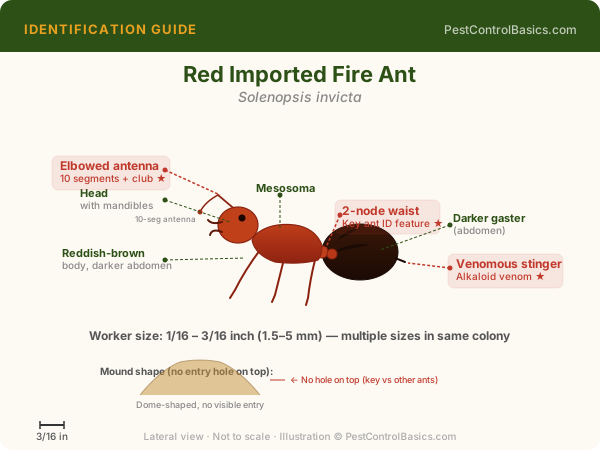
Original illustration by PestControlBasics.com. Use anatomical labels above to confirm your identification. For photo references, see the identification section below.
🔍 Identification Photo
Use this photo to confirm your identification. Click to enlarge.
Red imported fire ant (Solenopsis invicta) — reddish-brown workers 2–6mm; dome mound with no visible opening on top is the definitive sign
📷 Wikipedia / Wikimedia Commons / CC BY-SA⚠️ Photo loaded live from Wikipedia/Wikimedia Commons (CC BY-SA).
⚠️ Photos loaded from Wikipedia/Wikimedia Commons. Appearance varies by region, age, and sex.
They shouldn't be here. But they are.
The Red Imported Fire Ant (Solenopsis invicta) is not native to the United States. It originated in the wetlands of central South America — primarily Brazil, Argentina, and Paraguay — where natural predators, parasites, and competitors kept it in check.
The first documented U.S. arrival was in the 1930s through the Port of Mobile, Alabama, almost certainly via soil used as ballast in cargo ships. Without its natural enemies, the fire ant exploded across the American South, spreading at a rate of roughly 25 miles per year. By the 1950s, it had colonized most of the Southeast. Today it infests over 320 million acres across 14 southern states and Puerto Rico.
Cargo ships arriving from South America used soil and sand as ballast weight. When that ballast was dumped at port, fire ants — eggs, larvae, queens and all — came with it. A single mound can contain multiple queens, each capable of founding a new colony. Once the infestation started, it was essentially unstoppable.
The USDA spent billions attempting eradication in the 1950s–70s using pesticides like Mirex — which ultimately caused widespread environmental damage without eliminating the ant. Today the accepted strategy is not eradication, but control. Understanding this distinction will save you time, money, and frustration.
How to know it's a fire ant — not just any ant
Many homeowners mistake other ants for fire ants. The wrong identification leads to the wrong treatment. Here's exactly what to look for — both the ant itself and its telltale mound.
Roughly 1% of the U.S. population has a severe fire ant allergy. Anaphylaxis is possible within minutes of a sting. If someone is stung and shows signs of difficulty breathing, dizziness, or widespread hives, call 911 immediately. People with known insect allergies should carry an EpiPen and never treat fire ant mounds alone.
What they do — and when
Understanding fire ant behavior is the key to effective control. You're not just killing ants — you need to reach and eliminate the queen. A colony without a queen dies within months. Killing workers alone accomplishes almost nothing.
Colony Structure
A mature fire ant colony contains 100,000 to 500,000 workers of different sizes (called polymorphic workers), a few hundred winged males, and one or more queens. The queen's only job is reproduction — she can lay up to 1,500 eggs per day and live for 6–7 years. Workers live only 5–6 weeks.
Swarming & Reproduction
Fire ants reproduce through "nuptial flights" — winged males and females leave the colony on warm, humid days (typically spring after a rain). After mating in the air, males die and fertilized females (future queens) land, shed their wings, and attempt to start new colonies. One successful queen can build a visible mound within months.
Flooding Behavior
This surprises most homeowners: fire ant colonies do not drown. During floods, fire ants link their bodies together to form a living raft — sometimes the size of a basketball — that floats until it reaches dry land. This is how they spread after hurricanes and heavy rains. Never approach floating fire ant masses in floodwater.
The most effective DIY fire ant strategy is the "Two-Step Method" developed by Texas A&M AgriLife: (1) broadcast a bait product across the entire lawn in spring and fall, and (2) treat individual mounds with a contact insecticide. Bait reaches the queen; contact kills the workers. Together they're far more effective than either alone.
The right products — and how to use them
Most people grab a can of spray and drench the mound. That kills workers on the surface and drives the queen deeper — she's gone in hours, survivors rebuild within weeks, and you're back where you started. Here's what actually works.
The products below require a licensed pesticide applicator in most states. They are significantly more effective than OTC alternatives. If you're dealing with a severe or recurring infestation, hiring a licensed pest control professional may be more cost-effective than repeated DIY attempts.
Most natural fire ant remedies (boiling water, orange oil, diatomaceous earth, grits) have very low effectiveness against mature colonies. They may kill some workers but rarely reach or sterilize the queen. For a serious infestation, we recommend combining any natural method with proven baits. Here's what actually works in the natural category:
🐜 Also see: All Ant Species Guide — Pavement ants, odorous house ants, Argentine ants, pharaoh ants, and more.