Venomous Species Present Insider Knowledge Sprays Don't Work

Spider
Control

The truth the pest control industry rarely tells you

Spray barriers don't work on spiders — and most pest companies know it. Spiders don't groom themselves, so they never absorb the chemical. The only proven solution is one most homeowners have never heard of.

Sprays Effective?No — spiders don't groom
Best TreatmentDesiccant dusts
Dangerous SpeciesBrown Recluse, Black Widow
Entry PointsGaps, pipes, stored boxes
🕷️
Brown Recluse — Quick Reference
Most misidentified dangerous spider
Size1/4 – 3/4 inch body
ColorLight to dark brown, uniform
MarkingViolin/fiddle shape on back (not always visible)
Eyes6 eyes in 3 pairs (most spiders have 8)
Web TypeIrregular, messy, low to ground
Where FoundClosets, boxes, shoes, basement
VenomNecrotic — Seek Medical Care
Spray Works?No — use desiccant dust
📐 FIELD GUIDE ILLUSTRATION
Wolf spider (Lycosidae family) identification illustration with labeled anatomical features — PestControlBasics.com

Original illustration by PestControlBasics.com. Use anatomical labels above to confirm your identification.
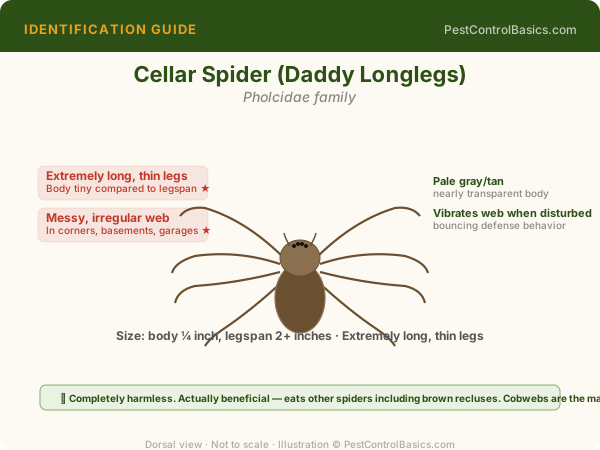
📐 FIELD GUIDE ILLUSTRATION
Cellar Spider (Pholcidae) identification illustration with labeled anatomical features — PestControlBasics.com

Original illustration by PestControlBasics.com. Use anatomical labels above to confirm your identification.
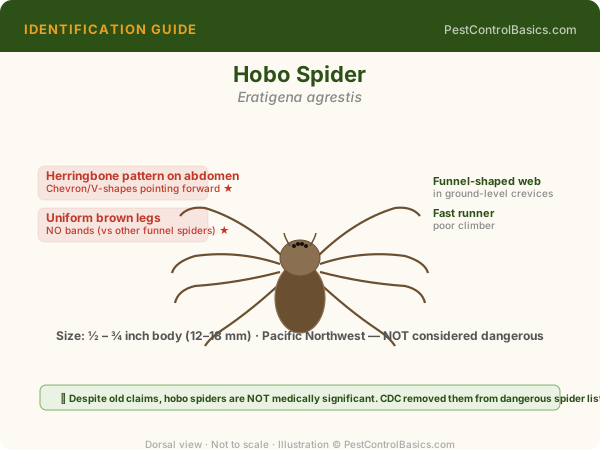
📐 FIELD GUIDE ILLUSTRATION
Hobo Spider (Eudioptilus agrestis) identification illustration with labeled anatomical features — PestControlBasics.com

Original illustration by PestControlBasics.com. Use anatomical labels above to confirm your identification.
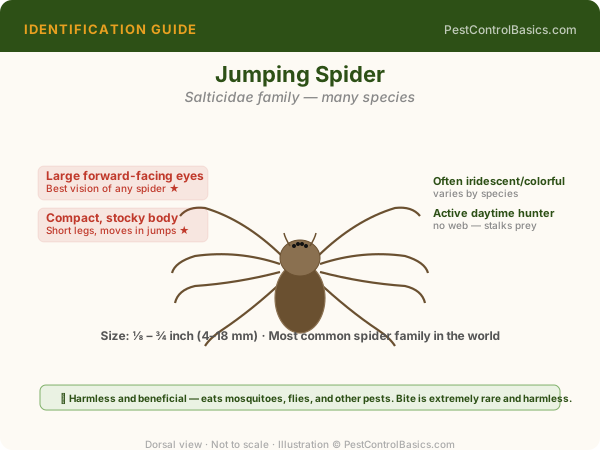
📐 FIELD GUIDE ILLUSTRATION
Jumping Spider (Salticidae) identification illustration with labeled anatomical features — PestControlBasics.com

Original illustration by PestControlBasics.com. Use anatomical labels above to confirm your identification.
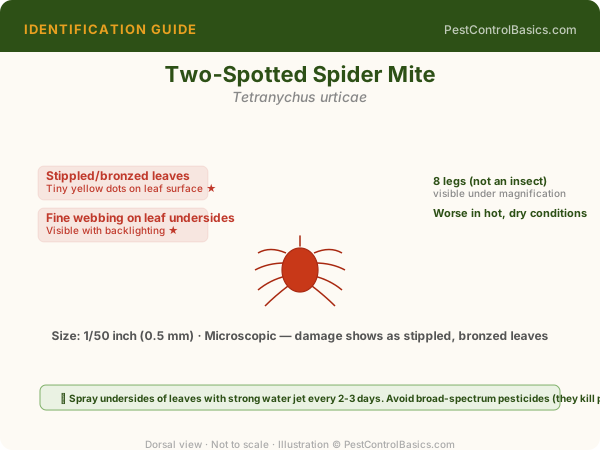
📐 FIELD GUIDE ILLUSTRATION
Spider Mite (Tetranychidae) identification illustration with labeled anatomical features — PestControlBasics.com

Original illustration by PestControlBasics.com. Use anatomical labels above to confirm your identification.
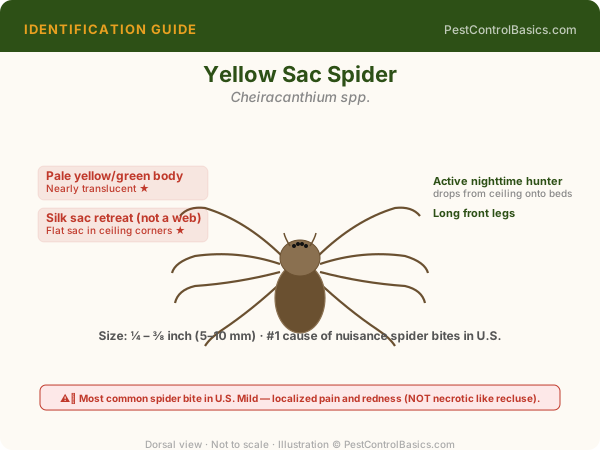
📐 FIELD GUIDE ILLUSTRATION
Yellow Sac Spider (Cheiracanthium spp.) identification illustration with labeled anatomical features — PestControlBasics.com

Original illustration by PestControlBasics.com. Use anatomical labels above to confirm your identification.

🔍 Identification Photo

Use this photo to confirm your identification. Click to enlarge.

Spider anatomy — 8 legs, 2 body regions, chelicerae (fangs), no antennae; these features distinguish all spiders from 6-

Spider anatomy — 8 legs, 2 body regions, chelicerae (fangs), no antennae; these features distinguish all spiders from 6-legged insects

📷 Wikipedia / Wikimedia Commons / CC BY-SA

⚠️ Photo loaded live from Wikipedia/Wikimedia Commons (CC BY-SA).

⚠️ Photos loaded from Wikipedia/Wikimedia Commons. Appearance varies by region, age, and sex.

The Most Important Thing On This Page

Why every spray you've tried hasn't worked

Industry Insider Knowledge
Spiders walk across chemical barriers without absorbing them — because they don't groom.

When you spray a baseboard or perimeter with insecticide, it works on most insects because they groom themselves — licking their legs, cleaning their antennae — and in doing so, they ingest the chemical and die.

Spiders don't groom. They walk across a treated surface, their long legs barely touching it, and continue on their way completely unaffected. The spray that kills ants dead in their tracks does almost nothing to spiders.

The solution is desiccant dust — a powder that physically destroys the spider's waxy cuticle through direct physical contact. It doesn't need to be ingested. It clings to legs and body, causes dehydration through the exoskeleton, and kills the spider within hours. It's the one treatment method where the spider's grooming behavior doesn't matter.

✗ Spray Barriers — Why They Fail
  • Spiders don't groom — no ingestion of chemical
  • Long legs keep body away from treated surface
  • Pyrethroids break down in UV within days outdoors
  • Repellent effect simply redirects spiders indoors
  • Does not affect egg sacs or juveniles in cracks
  • Creates chemical resistance over time
✓ Desiccant Dust — Why It Works
  • Physical kill — destroys waxy cuticle on contact
  • No ingestion needed — affects legs and body equally
  • Lasts years undisturbed in wall voids and cracks
  • Zero chemical resistance possible (physical mechanism)
  • Kills spiders in harborage where sprays never reach
  • Also kills other insects — addresses food source
Species Identification

Know what you're dealing with

Most spiders found in U.S. homes are harmless and actually beneficial — they eat the insects you don't want. The two species that genuinely require action are the Brown Recluse and Black Widow. Here's how to tell the difference.

Medically Significant
🕷️
Brown Recluse
Loxosceles reclusa
The most medically important spider in the U.S. Its necrotic venom can cause tissue death requiring surgical debridement. Found throughout the midwest and south. Lives in undisturbed areas — closets, attics, shoes, stored boxes. Identified by violin marking on back and 6 eyes (not 8). Rarely aggressive — most bites occur when spider is compressed against skin.
South & MidwestDark ClosetsStored Items
Medically Significant
Black Widow
Latrodectus mactans
Shiny black with the distinctive red hourglass marking on the underside of the abdomen. Neurotoxic venom — causes severe muscle cramps, spasms, and pain lasting days. Found in garages, woodpiles, mailboxes, outdoor structures. Webs are distinctive: strong, messy, irregular, built close to the ground in dark corners. Responsible for the most spider-related emergency room visits in the U.S.
All U.S.GaragesWoodpiles
Generally Harmless
🕸️
Wolf Spider
Hogna carolinensis
Large, hairy, fast-moving — and absolutely terrifying to most homeowners. But wolf spiders are harmless hunters that don't build webs. They chase prey on the ground. Bite only if handled. Found at ground level, often entering homes in fall seeking warmth. Common across all U.S. regions. Desiccant dust along baseboards and entry points is the correct treatment — sprays are largely ineffective.
All U.S.Ground LevelFall Invader
Harmless
🕸️
Cellar Spider
Pholcus phalangioides
The "daddy long legs" spider — long thin legs, small body, builds loose webs in corners and basements. Completely harmless. Actually beneficial — will prey on other spiders including brown recluses. The myth that daddy long legs have the world's most toxic venom is entirely false. If you have cellar spiders, leave them alone — they're working for you.
All U.S.BasementsBeneficial
Harmless
🌐
Orb Weaver
Araneidae family
The beautiful circular web spiders you see in gardens and on exterior walls in summer and fall. Not medically significant. Their webs catch nuisance insects constantly. If found near entry points, seal the gaps — they're indicating insect activity that's drawing them in. Removing the web just causes them to rebuild. Address the food source instead.
OutdoorSeasonalBeneficial
Caution
🟤
Hobo Spider
Eratigena agrestis
Found primarily in the Pacific Northwest. Previously thought to cause necrotic bites similar to the brown recluse — recent research has significantly revised this assessment downward. Still worth controlling due to size and aggressive behavior when cornered. Builds funnel webs at ground level. Treat with desiccant in harborage areas and seal entry points.
Pacific NWGround LevelFunnel Web
Treatment Guide

The desiccant protocol — step by step

Here is the complete treatment sequence for spider control. This is what works — not what most people do.

🪟
#1 Treatment — Desiccant Dust
CimeXa Insecticide Dust (Amorphous Silica Gel)
Why it's #1: CimeXa is amorphous silica gel — not diatomaceous earth (which requires more contact time). It works faster, lasts longer, and is effective at lower humidity than DE. Apply a very thin layer (barely visible) with a bulb duster into cracks, voids, along baseboards, inside wall outlets (after cutting power), under appliances, and any gap larger than 1/16 inch. A light dusting is more effective than a heavy coat — heavy application causes spiders to walk around it. Lasts 10+ years undisturbed in wall voids.
★★★★★
Best Method
🌿
Alternative Desiccant — Food Grade
Diatomaceous Earth, Food Grade (Harris or Safer Brand)
How it works: Fossilized diatom shells with microscopic sharp edges that physically pierce the cuticle. Slower than CimeXa but completely non-toxic to mammals. Good choice for areas with pets or children. Apply in the same locations as CimeXa. Food-grade DE is safe — pool-grade DE is not (different particle size, lung hazard). Loses effectiveness when wet — reapply after moisture exposure.
★★★★Ⓒ
Good — Pet Safe
🔒
Exclusion — Address the Root Cause
Weatherstripping + Caulk + Door Sweeps
Why this matters: Spiders enter homes through gaps around pipes, windows, doors, and utility penetrations. They follow their food source — insects. Sealing entry points is more effective long-term than any chemical treatment. Focus on: door sweeps on all exterior doors, caulk around window frames and pipe penetrations, seal gaps around attic vents and crawlspace openings. Foam backer rod + exterior caulk for large gaps.
★★★★★
Long-Term Fix
💡 Reduce the Food Source

Spiders follow insects. If you have a lot of spiders, you have a lot of insects they're feeding on. Treating the underlying insect problem (gnats, flies, moths, silverfish) reduces spider activity more effectively than targeting spiders directly. Turn off or redirect exterior lights at night — lights attract flying insects, which attract spiders to build webs near your entry points.

⚠ Brown Recluse Special Protocol

For confirmed brown recluse infestations, add glue board traps throughout the affected area — under furniture, inside closets, behind appliances. Brown recluses are wanderers that travel at night. Glue boards serve as both monitoring and population reduction. In severe infestations, professional whole-room treatment with pyrethrin dust injection into wall voids is the most effective approach. Do not attempt to handle brown recluses — any compression against skin risks a bite.

Prevention

Keep them out permanently

Reduce Outdoor Harborage

Move firewood at least 20 feet from the house and store it elevated off the ground. Remove leaf piles, mulch, and dense groundcover within 12 inches of the foundation. These provide ideal harborage for spiders and their prey alike.

Interior Decluttering

Brown recluses specifically prefer undisturbed clutter — stacked boxes, stored clothes, piles of papers. In affected areas, store items in sealed plastic bins rather than cardboard boxes. Shake out shoes and clothing stored in closets before wearing. Regular vacuuming in corners, under furniture, and along baseboards removes egg sacs and webs.

Exterior Lighting Strategy

Replace white exterior bulbs with yellow sodium vapor or warm LED bulbs — these attract significantly fewer flying insects, which reduces the spider food source near your home. Motion-activated lights are better than always-on lights for the same reason.

Annual Desiccant Application

A once-per-year application of CimeXa dust into wall voids, attic spaces, and crawlspaces creates a long-lasting barrier. Unlike sprays that break down within weeks, desiccant in enclosed voids lasts for years. This is the closest thing to a "set it and forget it" spider treatment that actually works.

📚 Sources: CDC Venomous Spiders · EPA Safe Pest Control
Published: Jan 1, 2025 · Updated: Apr 7, 2026
SpiderControl
SpiderControl

Frequently Asked Questions

How do I know if I have SpiderControl?

Signs of SpiderControl include physical sightings, droppings or frass, damage to food or materials, and unusual odors. Inspect hidden areas like wall voids, behind appliances, and in storage spaces. A flashlight inspection after dark is often most revealing.

Are SpiderControl dangerous to humans or pets?

SpiderControl can pose health risks including bites, allergic reactions, food contamination, and disease transmission. Children, elderly, and pets are especially vulnerable. Consult a pest management professional when an infestation is confirmed.

Can I eliminate SpiderControl myself?

Light infestations may be manageable with DIY baits, traps, and targeted treatments. Established infestations typically require professional intervention. Misapplied products often scatter pests and worsen the problem long-term.

How long does SpiderControl treatment take?

Timelines vary by infestation size and method. Baits may take 1–4 weeks to work through a colony. Chemical treatments often require 2–3 applications spaced 2–4 weeks apart. Monitor for 30–60 days after treatment to confirm elimination.

What attracts SpiderControl to my home?

SpiderControl are typically drawn by food sources, standing moisture, warmth, and shelter. Sealing entry points, reducing clutter, fixing leaks, and storing food in airtight containers are the most effective long-term prevention measures.

Related Resources

📚 Full Pest Library🧪 DIY vs. Pro Quiz💰 Cost Guide🌿 IPM Guide🔍 Find a Pro
🧪 Recommended Treatment Products
Peppermint Oil (Repellent) Bifenthrin Perimeter Natural Pest Control Guide
Full product guides with mixing rates, safety info, and brand comparisons. → Browse All 121 Pesticide Guides
🔗 Related Pests
Wolf Spider Hobo Spider Cellar Spider Jumping Spider Black Widow
Compare similar pests to confirm your identification. → Use our ID Flowchart
🔮
Reviewed by Derek GiordanoContent on PestControlBasics.com is developed with input from certified pest management professionals and cross-referenced against EPA, CDC, and university extension guidance. Last reviewed: April 2026.

🗺️ US Distribution — Spider Control Guide

image/svg+xml
Common Occasional Not Present
States Present
49
Occasional
2
Primary Region
Continental US
📊 Source: University extension services, USDA, CDC vector data, and published entomological surveys.