Invasive from Asia Fall Home Invader Seal Before September

Stink
Bugs

Halyomorpha halys — Brown Marmorated Stink Bug

They don't bite, sting, or cause structural damage. But they invade homes by the hundreds every fall, and squishing them releases a pungent odor that attracts more. The only real solution is exclusion — seal every entry point before September.

OriginChina — arrived in PA ~1996
Now In40+ states & spreading
Invasion SeasonLate September – November
Do They Bite?No — completely harmless to humans
🦐
Quick Reference Card
Brown Marmorated Stink Bug
Size5/8 inch — shield-shaped body
ColorMottled brown-gray, banded antennae
ShapeGeometric shield — distinctive pentagonal
SmellCilantro / coriander — when threatened
InvadesSeptember–November seeking warmth
Dangerous?No — nuisance only
Squish?NEVER — releases odor + attracts more
Best controlSeal before September — vacuum indoors
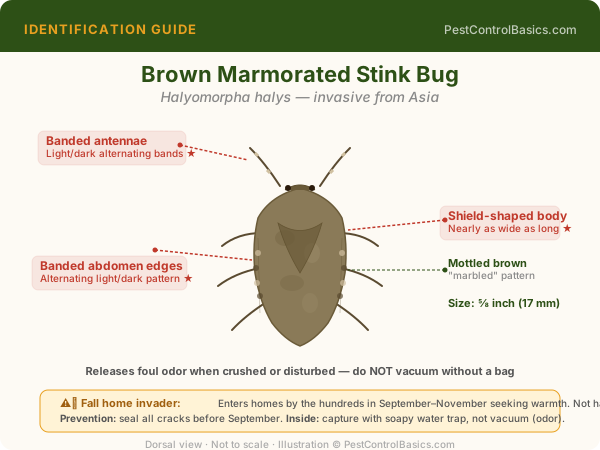
📐 FIELD GUIDE ILLUSTRATION
Brown marmorated stink bug (Halyomorpha halys) identification illustration with labeled anatomical features — PestControlBasics.com

Original illustration by PestControlBasics.com. Use anatomical labels above to confirm your identification.

🔍 Identification Photo

Use this photo to confirm your identification. Click to enlarge.

Brown marmorated stink bug (Halyomorpha halys) — mottled brown shield shape with alternating banding on abdomen edge; ne

Brown marmorated stink bug (Halyomorpha halys) — mottled brown shield shape with alternating banding on abdomen edge; never crush them indoors

📷 Wikipedia / Wikimedia Commons / CC BY-SA

⚠️ Photo loaded live from Wikipedia/Wikimedia Commons (CC BY-SA).

⚠️ Photos loaded from Wikipedia/Wikimedia Commons. Appearance varies by region, age, and sex.

Origin & Invasion Biology

Why they show up every fall — like clockwork

The Brown Marmorated Stink Bug arrived in Allentown, Pennsylvania from East Asia around 1996 — likely in shipping containers. Without the parasitic wasps that control them in Asia, their population expanded explosively. They now occur in 40+ states and are established in most of the eastern U.S., with expanding populations in the Pacific Northwest and California.

What triggers the fall invasion is straightforward: dropping temperatures cause them to enter "diapause" — a dormant overwintering state. They seek warm, protected spaces to wait out winter. Your home, particularly warm sunny sides and attic spaces, is ideal. They release aggregation pheromones that attract other stink bugs to the same overwintering sites — which is why the same homes see repeated invasions year after year.

🛑 Never Squish a Stink Bug Indoors

Squishing a stink bug releases two things: the pungent odor (which smells like coriander or cilantro) and aggregation pheromones that actively signal to other stink bugs that this is a good overwintering site. You will attract more. Use a jar, bag, or vacuum to capture and remove them without crushing. Flush down a toilet or release outside — far from the structure.

📅 Stink Bug Annual Calendar — When to Act
Jan
Dormant
Feb
Dormant
Mar
Emerge
Apr
Outdoors
May
Feeding
Jun
Breeding
Jul
Active
Aug
⚠ SEAL NOW
Sep
🛑 Invasion starts
Oct
🛑 Peak invasion
Nov
⚠ Tapering
Dec
Dormant
📅 The August Rule

All stink bug exclusion work must be completed by late August — before the first cold nights trigger migration toward structures. By September, they are actively seeking entry. Sealing in October doesn't stop the invasion; it just traps some already inside. August is your window.

Exclusion — The Only Real Solution

Seal every gap before September

Insecticides provide limited help against stink bugs — they move quickly and contact time with treated surfaces is brief. Exclusion is the only effective strategy. Use this checklist every August.

✓ August Stink Bug Exclusion Checklist
Window and door weatherstripping
Replace any compressed, cracked, or missing weatherstripping. Even a 1/4 inch gap is sufficient for stink bug entry.
Door sweeps on all exterior doors
Include garage doors. Stink bugs enter under doors with daylight clearance. Install heavy-duty sweeps with brush seals.
Window screen integrity
Check every screen for holes and tears — even small ones. Repair with screen patch kits or replace damaged screens before August.
Utility penetrations — pipes, cables, AC lines
Seal gaps around all exterior pipe and cable penetrations with exterior caulk or foam. A common entry point that's easy to overlook.
Attic vents and crawlspace vents
Install fine mesh screens (1/16 inch) over attic and crawlspace vents. These are major entry points for attic overwintering.
Chimney with damper or cap
Open chimneys are highways for stink bugs and other overwintering insects. Install a chimney cap with mesh screening.
Perimeter caulking — siding and trim
Walk the exterior and caulk any gap where siding meets trim, windows, or foundation. Use paintable exterior caulk.
Exterior light management
Stink bugs are attracted to light. Replace white exterior bulbs with yellow LED or sodium vapor — significantly less attractive to insects.
Safe Indoor Removal

When they're already inside — remove without releasing odor

The Vacuum Method — Best Indoor Removal

Vacuum stink bugs up with a shop vac or regular vacuum. Important: empty the vacuum immediately into a sealed bag placed outside. Stink bugs in a vacuum bag will release odor into your home through the motor exhaust. A stocking over the vacuum nozzle can trap bugs before they reach the bag — remove the stocking and seal it in a bag outdoors.

The Jar Method — For Individual Bugs

Place a glass jar or zip-lock bag over the bug (don't touch it), slide a piece of paper underneath, and capture it. Seal and dispose outside. Drop into soapy water — the detergent breaks surface tension and they drown quickly without releasing odor.

Soapy Water Trap

A shallow container of soapy water placed under a desk lamp (the only light source in a dark room) attracts stink bugs overnight. They fly toward the light, fall into the water, and drown. Effective for reducing indoor populations without contact or squishing.

🏠
Perimeter Spray — Outdoor Entry Point Treatment
Bifenthrin Perimeter Spray (Talstar, Bifen IT)
How it works: Applied to the exterior of the structure in August — around windows, doors, eaves, and the foundation — creates a contact-kill zone for stink bugs landing on the structure before entry. Provides 4–6 weeks of residual. Must be applied before invasion begins. Re-apply in late September if activity continues. Combine with exclusion for maximum effectiveness — spray alone without sealing gaps is insufficient.
★★★ⒸⒸ
Supplemental
🌿 No Good Indoor Chemical Treatment Exists

There is no indoor pesticide treatment that effectively controls stink bugs already inside. Sprays kill individuals on contact but do not provide meaningful residual control for a species that's constantly re-entering. Indoor pesticide application for stink bugs is not recommended — exclusion and manual removal are the only effective indoor strategies.

📚 Sources: EPA Termite Guide · NPMA Termite Info
Published: Jan 1, 2025 · Updated: Apr 7, 2026
StinkBugs
StinkBugs

Frequently Asked Questions

How do I know if I have StinkBugs?

Signs of StinkBugs include physical sightings, droppings or frass, damage to food or materials, and unusual odors. Inspect hidden areas like wall voids, behind appliances, and in storage spaces. A flashlight inspection after dark is often most revealing.

Are StinkBugs dangerous to humans or pets?

StinkBugs can pose health risks including bites, allergic reactions, food contamination, and disease transmission. Children, elderly, and pets are especially vulnerable. Consult a pest management professional when an infestation is confirmed.

Can I eliminate StinkBugs myself?

Light infestations may be manageable with DIY baits, traps, and targeted treatments. Established infestations typically require professional intervention. Misapplied products often scatter pests and worsen the problem long-term.

How long does StinkBugs treatment take?

Timelines vary by infestation size and method. Baits may take 1–4 weeks to work through a colony. Chemical treatments often require 2–3 applications spaced 2–4 weeks apart. Monitor for 30–60 days after treatment to confirm elimination.

What attracts StinkBugs to my home?

StinkBugs are typically drawn by food sources, standing moisture, warmth, and shelter. Sealing entry points, reducing clutter, fixing leaks, and storing food in airtight containers are the most effective long-term prevention measures.

Related Resources

📚 Full Pest Library🧪 DIY vs. Pro Quiz💰 Cost Guide🌿 IPM Guide🔍 Find a Pro
🧪 Recommended Treatment Products
Bifenthrin Lambda-Cyhalothrin IPM Guide
Full product guides with mixing rates and safety info. → Browse All 130 Pesticide Guides
🎬
Stink Bug Prevention for Fall
Video guide coming soon — subscribe to be notified when it's live
▶️ Subscribe on YouTube 🔍 Use ID Flowchart Instead
🔮
Reviewed by Derek GiordanoContent on PestControlBasics.com is developed with input from certified pest management professionals and cross-referenced against EPA, CDC, and university extension guidance. Last reviewed: April 2026.

🗺️ US Distribution — Stink Bugs

image/svg+xml
Common Occasional Not Present
States Present
32
Occasional
6
Primary Region
Eastern United States
📊 Source: University extension services, USDA, CDC vector data, and published entomological surveys.