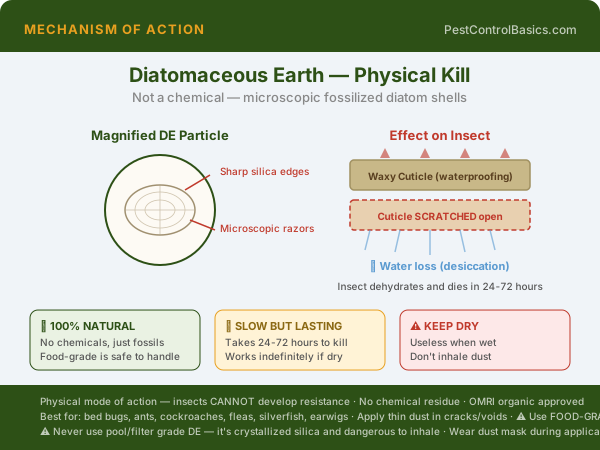
How diatomaceous earth works — illustrated mechanism of action · PestControlBasics.com
How diatomaceous earth works — illustrated mechanism of action · PestControlBasics.com
Two of the safest and most underused pest control tools available. Both work physically rather than chemically — and neither loses effectiveness over time the way synthetic insecticides can.
Boric acid works via two pathways. First, when insects walk through boric acid powder, it adheres to their legs and body via electrostatic attraction and mechanical sticking. Insects groom themselves regularly — when they ingest the boric acid while grooming, it disrupts their digestive system and metabolism, causing death within 72 hours.
Second, boric acid is mildly abrasive and acts as a desiccant — physical damage to the insect cuticle allows water loss. This physical action means insects cannot develop resistance to boric acid, unlike synthetic insecticides.
The application secret: Apply a very thin, barely visible layer — if you can see a pile of powder, you've used too much. Insects avoid heavy boric acid deposits. The effective application is a light dusting that insects walk through without detecting.
Less is more with boric acid. A visible white pile repels cockroaches. A barely-there dusting that coats surfaces is lethal. Use a bulb duster set to puff the minimum amount — coat the surface, not pile it up.
Boric acid has a mammalian LD50 of 2,660 mg/kg (rat oral) — less toxic than table salt. It is used in eye wash products. Safe around pets and children when applied in inaccessible areas (inside walls, under appliances). Not for use on food preparation surfaces.
Boric acid loses all effectiveness when it gets wet — it dissolves and no longer has the physical desiccant or adherence properties needed to work. Apply only in dry, protected locations. Under-sink areas with plumbing drips will not maintain effective boric acid treatments.
Diatomaceous earth (DE) has been the standard desiccant dust for decades — but CimeXa is significantly superior for indoor pest control. CimeXa's amorphous silica particles are much smaller and have far greater surface area than crystalline DE, meaning they adhere to insect cuticles with dramatically higher efficiency and cause faster dehydration.
In independent studies comparing CimeXa to DE against bed bugs, CimeXa produced 100% mortality within 24 hours. Food-grade DE required 7+ days for the same effect. For time-sensitive applications, there is no comparison.
CimeXa also electrostatically clings to surfaces and insects far better than DE — it fluffs into a fine cloud when applied and settles on every surface in treated areas, including vertical walls and ceilings. This makes it ideal for wall voids, electrical outlets, and any area where DE's heavier particles would settle out of position.
CimeXa applied around the perimeter of a mattress encasement, along baseboards, and in electrical outlets creates a kill zone that eliminates bed bugs walking from wall to bed or bed to wall. Combined with heat treatment or other methods, it's the most effective supplemental treatment for bed bug control. Any bed bug walking through a CimeXa-treated area dies within hours.
Apply with a bulb duster in a very thin layer — CimeXa should be nearly invisible after application. It is so fine that it creates a light "fog" when puffed, settling evenly across all surfaces. For wall voids, drill a 1/2-inch hole and puff the duster inside — the cloud fills the void and settles on every surface. For electrical outlets: remove the face plate, puff lightly inside, replace plate.
CimeXa remains effective in protected indoor environments for 10+ years when undisturbed. It does not break down chemically. Moisture temporarily reduces effectiveness but restores upon drying.
CimeXa's active ingredient (amorphous silica gel) is on the FDA's GRAS (Generally Recognized as Safe) list and is used in food packaging. Mammalian LD50 exceeds 3,160 mg/kg. Safe around pets and children once settled — avoid inhaling during application (use an N95 mask).