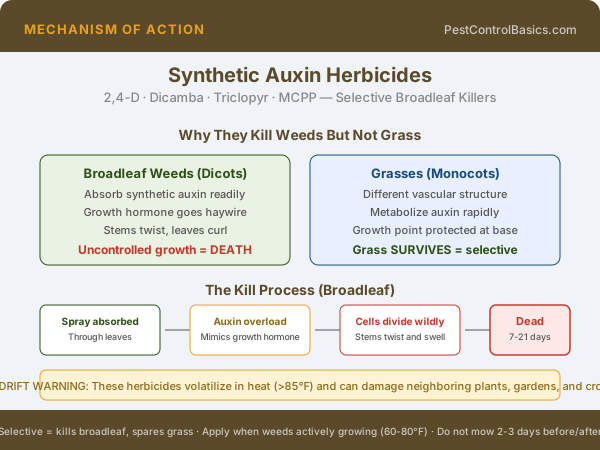
How herbicide auxin works — illustrated mechanism of action
Dicamba is a selective broadleaf herbicide commonly combined with 2,4-D in lawn weed killer products. It controls tough weeds that 2,4-D alone cannot handle, including clover, ground ivy (creeping charlie), and knotweed. Highly effective but notorious for off-target drift damage.
How herbicide auxin works — illustrated mechanism of action
Broadleaf lawn weeds: clover, ground ivy/creeping charlie, henbit, chickweed, knotweed, purslane, wild violets, thistle, plantain. Selective - does not harm established grasses at labeled rates. Often combined with 2,4-D and MCPP for broadest weed spectrum.
Most lawn weed killers contain dicamba as part of a 3-way mix: Trimec (2,4-D + dicamba + MCPP), Weed B Gon (Ortho), Spectracide Weed Stop, BioAdvanced All-in-One Lawn Weed and Crabgrass Killer, Speed Zone, Celsius (warm-season turf). Standalone dicamba: Banvel, Clarity, XtendiMax (agricultural).
Moderate toxicity to mammals. Low toxicity to birds and bees. The primary concern with dicamba is NOT direct toxicity but off-target drift damage to neighboring plants, gardens, and crops.
For lawn use: Dicamba is safe and effective as part of three-way broadleaf lawn herbicides (Trimec, Weed B Gon, etc.) when used at labeled rates. Apply when temperatures are between 60-80F. Do NOT apply if forecast calls for temperatures above 85F in the 48 hours following application - volatilization risk increases dramatically.
For creeping charlie: Dicamba is one of the most effective herbicides for ground ivy (creeping charlie), which is one of the toughest lawn weeds to control. Fall application (September-October) when creeping charlie is actively transporting nutrients to roots gives the best results.
Protecting nearby plants: Do not apply dicamba when wind exceeds 5 mph. Do not apply near vegetable gardens, flower beds, or valuable ornamentals. Use a shield or cardboard barrier when spot-spraying near desired plants. Avoid application on hot days when volatilization is likely.
The agricultural controversy: Dicamba-tolerant soybeans (Xtend system) launched in 2017 led to widespread drift damage to non-tolerant crops across the Midwest. Millions of acres of soybeans, peaches, tomatoes, and other crops were damaged. This led to EPA restrictions, state bans, and ongoing litigation. The homeowner formulations at much lower concentrations carry less drift risk but the principle remains - dicamba moves.