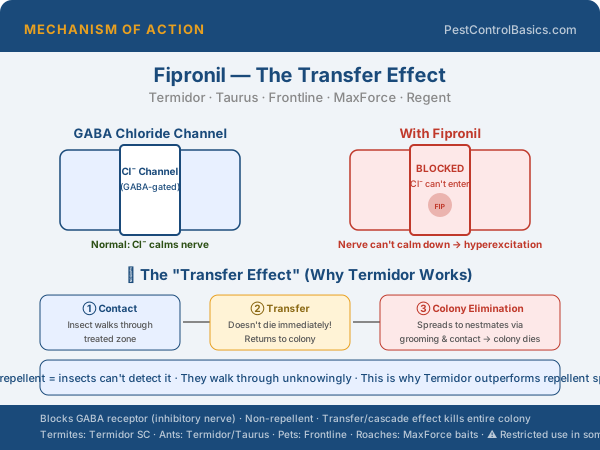
Why fipronil eliminates colonies — not just individuals
Most insecticides kill insects that contact them directly. Fipronil does something fundamentally different: it is completely undetectable to insects, allows them to continue normal social behavior after contact, and uses that social behavior to spread the chemical throughout the colony.
This is why fipronil became the global termiticide standard within years of its 1996 introduction. Previous soil treatments (chlorpyrifos, permethrin) created repellent barriers that termites learned to route around. Fipronil creates an invisible kill zone — termites pass through it freely, carry it back to the colony, and distribute it through feeding and grooming behaviors to every member.
Where and how fipronil is used
Termite Soil Treatment: Termidor SC (the primary professional formulation) is injected into the soil around and under a structure's foundation at 4-inch intervals. The treated zone creates a continuous fipronil barrier in soil. This is the #1 termite treatment globally. Soil residual of 5–10 years. Licensed applicators only.
Fire Ant Perimeter Treatment: Taurus SC (same active ingredient as Termidor) is labeled for perimeter fire ant control. Applied around the structure, it eliminates fire ant colonies attempting to establish near the building. The transfer effect is particularly valuable for fire ants — their extremely social colony behavior accelerates chemical distribution.
Cockroach and General Pest Control: Phantom aerosol (chlorfenapyr is actually the active — see note below) — but commercial fipronil gel formulations are used professionally for cockroach bait. Consumer Maxforce FC Magnum contains fipronil as the bait active ingredient for German cockroaches.
Termidor SC and Taurus SC require a licensed pest control applicator in all states for structural termite treatment. The soil injection equipment, calibration, and application technique require professional training. Consumer fipronil products (Maxforce cockroach bait) are available without a license for cockroach control only.
Fipronil products on the market
| Product | Concentration | Use | Availability |
|---|---|---|---|
| Termidor SC | 9.1% | Structural termite soil treatment | Licensed Only |
| Taurus SC | 9.1% | Termite + fire ant perimeter | Licensed Only |
| Maxforce FC Magnum | 0.05% | Cockroach gel bait | OTC — Consumer |
| Maxforce Ant Bait Stations | 0.001% | Ant bait stations | OTC — Consumer |
| Termidor HP II | 9.1% | High-pressure foam for wall voids | Licensed Only |
| Frontline (veterinary) | 9.7% | Flea/tick on pets — vet product | Veterinary / OTC |
Critical safety notes
Fipronil is highly toxic to aquatic invertebrates and fish at very low concentrations. Never apply near water features, drainage ditches, or before rain. The slow degradation in soil means runoff from treated areas can affect aquatic systems for extended periods.
Fipronil is acutely toxic to bees and is classified as a highly hazardous pesticide for pollinators. Never apply to flowering plants or when bees are active. Its use in agricultural settings is restricted in many countries specifically due to pollinator concerns.
When used as a structural soil treatment (Termidor), fipronil poses minimal risk to pets and people at the concentrations and locations used (buried in soil around the foundation). The veterinary product Frontline demonstrates that fipronil can be safe for mammals in appropriate formulations. Follow all label re-entry intervals.