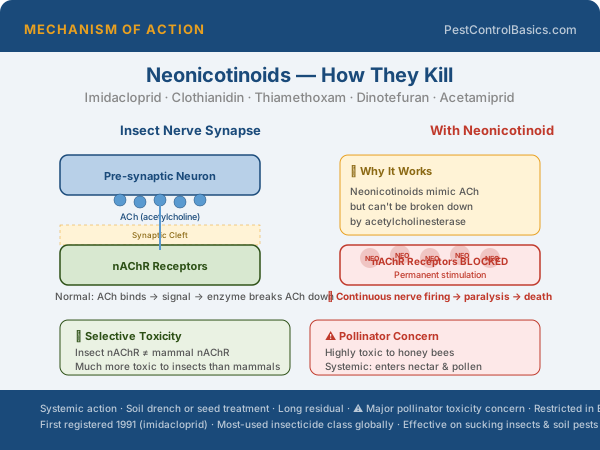
How imidacloprid moves through plants
The systemic mechanism makes imidacloprid uniquely effective for pests that are difficult to contact directly — aphid colonies hidden in curled leaves, scale insects under protective shells, and root-feeding grubs underground are all exposed when they feed on treated plant tissue.
However, this same systemic property is the source of its primary environmental concern: imidacloprid applied to flowering plants contaminates pollen and nectar with sublethal doses that affect bee navigation, learning, and reproduction.
Imidacloprid applied to soil around flowering plants (trees, shrubs, flowers) will be taken up systemically and appear in pollen and nectar. Even sublethal doses in nectar impair bee navigation, memory, and foraging behavior. Multiple scientific studies have linked neonicotinoid exposure to colony collapse disorder. Never apply imidacloprid to flowering plants or to soil within the root zone of flowering plants. Apply only to non-flowering plants or wait until after bloom.
What imidacloprid is used for
Tree and Shrub Protection: Soil drench or trunk injection for aphids, borers, scale insects, and other sap-sucking pests. Bayer Tree & Shrub Protect is the primary consumer product. Effective for 12 months in soil with a single application. Best for non-flowering trees and ornamental shrubs.
Termite Prevention: Premise SC (commercial) uses imidacloprid as a soil barrier for termite prevention — primarily for pre-construction treatment and supplemental treatment where Termidor has already been applied. Less persistent and less effective than fipronil for established termite treatment but approved for preventive use.
White Grub Control: Applied to lawns in spring or early summer before grubs hatch. Granule or liquid formulations are absorbed by turf roots and kill grubs as they feed on root tissue. One of the most effective grub control products available to homeowners.
Flea Control (veterinary): The active ingredient in Advantage flea products for pets. Applied topically, it spreads through skin oils and kills fleas on contact. Safe in veterinary formulations at appropriate concentrations.
Common imidacloprid products
| Product | Formulation | Use |
|---|---|---|
| Bayer Tree & Shrub Protect | 1.47% liquid | Soil drench for ornamental pests |
| Bonide Annual Tree & Shrub Insect Control | 1.47% liquid | Systemic tree/shrub protection |
| Dominion 2L | 21.4% concentrate | Professional — termites & general pests |
| Merit 0.5G | 0.5% granule | Grub control, lawn care |
| Bayer 24-Hour Grub Killer Plus | 0.5% granule | White grub lawn treatment |
| Advantage II (veterinary) | 9.1% topical | Flea control on cats/dogs |
| Premise SC | 21.4% | Professional termite soil treatment |
Using imidacloprid responsibly
Imidacloprid is highly effective for specific applications and poses real environmental concerns in others. The key is application site selection. Use for: lawn grub control (non-flowering grass), ornamental non-flowering trees, structural pest control, and veterinary flea products. Avoid for: any flowering plant, any plant near flowering neighbors, or any application where soil runoff could reach flowering vegetation or water.
For non-flowering ornamental shrubs with aphid or scale problems, imidacloprid soil drench is genuinely the best solution — one application protects for 12 months without repeated spraying. For white grub control in lawns (not garden beds), it's highly effective. The key is choosing application sites where systemic uptake stays out of flowering plant tissue and pollen.