☠️ Necrotic Venom🕷️ Recluse Family📍 Central & South U.S.
Brown Recluse Spider
Loxosceles reclusa
Reclusive, rarely aggressive, but carrying a venom that can destroy tissue. One of the most misidentified spiders in North America — and most "brown recluse bites" aren't. Here's the truth, where they actually hide, and why spray treatments fail completely on spiders.
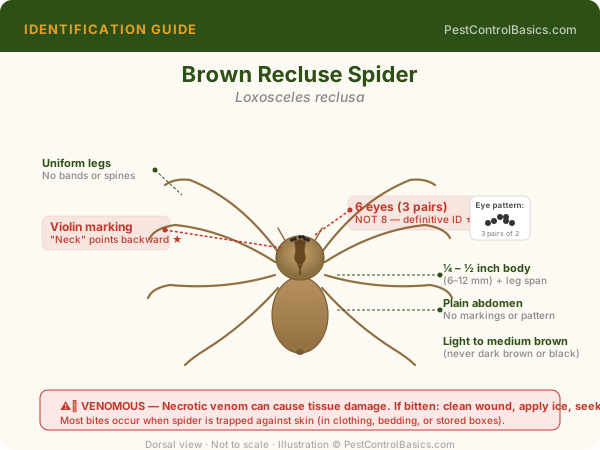
Original illustration by PestControlBasics.com. Use anatomical labels above to confirm your identification. For photo references, see the identification section below.
Identification — The Full Truth
The violin mark is real — but don't rely on it alone
The brown recluse is one of the most misidentified spiders in North America. Thousands of bites are attributed to brown recluses in states where the spider doesn't even exist. Correct identification requires multiple characteristics — the violin marking alone is unreliable and shared by several other spider species.
🎻
The Violin Mark — Myths vs. Reality
What you actually need to know about identifying a brown recluse
❌ Myth: The violin proves it
Many other harmless spiders have violin-shaped markings. The mark varies in intensity and can be hard to see. It cannot be used as a sole identification point — always look for additional features.
✅ Truth: Count the eyes
Most spiders have 8 eyes. Brown recluses have exactly 6 eyes in 3 pairs (dyads) arranged in a semicircle. This is the most reliable single feature — you'll need a magnifier to see clearly.
❌ Myth: They're everywhere in the U.S.
Brown recluse spiders are NOT found in most of the country. Their confirmed range is limited to the Midwest and South-Central states. Panic about brown recluses in California or the Northeast is almost always misidentification.
✅ Truth: Uniform coloring is key
A true brown recluse is a uniform tan or brown with NO pattern, banding, spines, or contrasting colors on the legs or abdomen. Any distinct markings or leg patterns means it's almost certainly a different species.
Body Size
¼ to ½ inch body. With legs extended, total span can reach 1 inch. Females are larger than males.
Web Type
Irregular, flat, wispy off-white web. Not the classic orb web. Built in dark corners, inside boxes, under objects.
Movement
Slow and deliberate. Retreats when disturbed rather than charges. Bites happen when trapped against skin in clothing or bedding.
Activity Pattern
Nocturnal — active at night, hiding during the day. Forages alone, does not form groups. Males wander more than females.
👁️
6
Eyes in 3 pairs — the definitive ID feature
🗺️
15
States in confirmed core habitat range
⏱️
2–8hr
Before venom symptoms typically appear
🏥
<1%
Bites that cause severe necrotic reaction
Venom & Medical
What the venom actually does — and when to get care
Brown recluse venom contains sphingomyelinase D — an enzyme that destroys cell membranes. This causes localized tissue death (necrosis) in severe cases. Importantly, the vast majority of bites are minor. Less than 1% result in significant necrotic wounds. Severity depends on the amount of venom injected, the individual's immune response, and the bite location.
Hours 0–2
🔴
Initial Sting
Mild burning or stinging. May be painless initially. Small red mark at site.
Hours 2–8
🟠
Reaction Builds
Redness, swelling, itching. A bullseye ring pattern may form around the bite.
Days 1–3
🩹
Blister Forms
Blister at center, surrounding tissue may go pale. Seek medical care at this stage.
Days 3–14
⚕️
Necrosis (Rare)
In rare severe cases, an open ulcerating wound develops. Requires medical wound management.
🏥 When to Seek Medical Care Immediately
Go to urgent care or ER if: confirmed or suspected brown recluse contact AND you develop a blister, spreading redness, or dark discoloration within 8 hours. Photograph the spider if possible. Tell the doctor you suspect brown recluse. Most bites are managed with wound care — no U.S. antivenom exists. Children, elderly, and immunocompromised individuals are at higher risk for severe reactions.
🔬 The Over-Reporting Problem
Research by spider expert Rick Vetter (UC Riverside) documented that the vast majority of suspected brown recluse bites occur in states where the spider doesn't exist. The most common actual cause: MRSA (Methicillin-resistant Staph aureus) skin infections, which look almost identical to necrotic spider bites. If you're outside the confirmed range, MRSA should be the first suspicion.
Behavior & Habitat
Where brown recluses actually live — and where bites happen
The name says everything: recluse. These spiders actively avoid human contact and seek the most undisturbed spaces available. Almost all bites happen when the spider is accidentally trapped against human skin.
📦
Cardboard Storage Boxes
Their favorite habitat. Corrugated cardboard mimics tree bark — their natural environment. Never reach blindly into stored boxes.
🔴 Highest risk location
👟
Shoes & Clothing on Floor
The most common bite scenario. Always shake out shoes before wearing. Check clothing left on the floor overnight, especially in affected states.
🔴 Most common bite scenario
🪵
Firewood & Wood Piles
Always wear leather gloves when handling firewood. Inspect before bringing indoors. Extremely common in wood piles across their range states.
🟠 High risk — use gloves
🔧
Garage & Storage Areas
Behind stored items, inside boxes, under workbenches. Any garage with cardboard storage is prime brown recluse habitat.
🟠 Very common location
🏚️
Attic Insulation
Undisturbed, dark, insulating — ideal. Always wear long sleeves, gloves, and eye protection when entering the attic in recluse states.
🟡 Wear full protection
🚿
Under Sinks & in Cabinets
Less common, but possible in heavy infestations. Check corners of under-sink cabinets when reaching deep inside.
🟡 Check in heavy infestations
The Industry Insider Secret
Why spray barriers fail completely on spiders
This is one of the most valuable pieces of information on this entire site. Most pest control companies don't explain this — they just spray and take your money.
🚫 The Four Reasons Pyrethroid Spray Doesn't Kill Spiders
🦵
Spiders Don't Groom
Pyrethroids kill insects when they walk through residue and then groom it off their legs. Spiders do not groom this way — they get minimal chemical exposure from walking across treated surfaces.
🦿
Leg-Tip Contact Only
A spider's body barely contacts the surface it walks on — only the very tips of its legs make contact. Absorption is a fraction of what an insect experiences, often below a lethal dose.
🔬
Different Biochemistry
Spiders require 4–7x higher pyrethroid doses than insects for equivalent kill. Standard consumer spray concentrations almost never achieve lethal levels on spider leg-tip absorption.
📦
Wrong Location
Brown recluse spiders live inside boxes, behind stored items, in wall voids. They never cross the baseboards you spray. The chemical goes where the spider isn't.
✅ What Actually Works: Desiccant Dust + Sticky Traps
CimeXa desiccant dust works via a physical mechanism — it absorbs the waxy cuticle, causing death by dehydration. Spiders cannot develop resistance to physical desiccation. Apply inside boxes, behind stored items, in closet corners, under appliances. Effective for 10+ years if undisturbed.
Sticky flat traps placed along walls and in corners serve two purposes: they catch spiders AND give you a population count to measure whether treatment is working. 20+ spiders per week = significant infestation requiring professional help.
Treatment Protocol
The approach that actually eliminates brown recluse
⚪
Desiccant Dust — Primary Treatment
CimeXa Insecticide Dust (Amorphous Silica Gel)
How to use: Apply thin layers with a bulb duster inside cardboard boxes, behind stored items, under appliances, along attic joists, inside wall voids through outlet covers, in closet corners. A thin layer works better than thick — spiders walk through it, not over it. Kills within hours. Remains effective 10+ years undisturbed. This is the professional approach most consumer guides omit entirely.
★★★★★
Best Choice
🌿
Natural Desiccant — Outdoor & Damp Areas
Diatomaceous Earth (Food Grade)
Natural option: Same physical kill mechanism but slower. Loses effectiveness when wet — better for perimeter application and drier environments. Always use food-grade, never pool-grade. Wear a dust mask when applying. Replace after rain or moisture exposure.
★★★★☆
Good — Natural
🟨
Monitoring & Population Control
Flat Sticky Spider & Insect Monitors
Dual purpose: Catches spiders AND tells you where activity is highest. Place along walls (spiders travel edges), in closets, under beds, behind appliances, in storage areas. Count catches weekly — this is your infestation gauge. Modest population: 1–5/week. Concerning: 10+/week. Severe: 20+/week (call a professional). No chemicals, safe anywhere in the home including kitchens and children's rooms.
★★★★★
Essential Tool
📦
Habitat Removal — Highest Impact
Replace Cardboard with Sealed Plastic Storage Bins
The single biggest change you can make: Cardboard boxes are the primary brown recluse habitat in homes — they mimic tree bark perfectly. Replacing all cardboard storage with sealed plastic bins eliminates the root cause of most indoor brown recluse populations. Pair with CimeXa in storage areas and you've addressed the habitat, not just the symptoms.
★★★★★
Root Cause Fix
🔧
Perimeter Exclusion
Exterior Caulking & Door Sweeps
Stop new entry: Seal gaps around exterior pipes, cracks in foundation, gaps under doors, and around window frames. Brown recluse spiders are flat and can enter through very small gaps. Add door sweeps to any exterior door with a visible gap. Focus especially on garage doors, basement entries, and utility penetrations.
★★★★☆
Prevention
👷 When to Call a Professional for Brown Recluse
Call a professional when: sticky trap counts exceed 20 spiders per week, the infestation is inside wall voids (requires injection equipment), the home is large with extensive storage, or you've done a thorough DIY treatment and still see significant activity after 6 weeks. When hiring a pro, specifically request desiccant dust treatment — not pyrethroid spray. A knowledgeable technician will understand why. If a company just wants to spray baseboards, find a different company.
Reviewed by Derek GiordanoContent on PestControlBasics.com is developed with input from certified pest management professionals and cross-referenced against EPA, CDC, and university extension guidance. Last reviewed: April 2026.