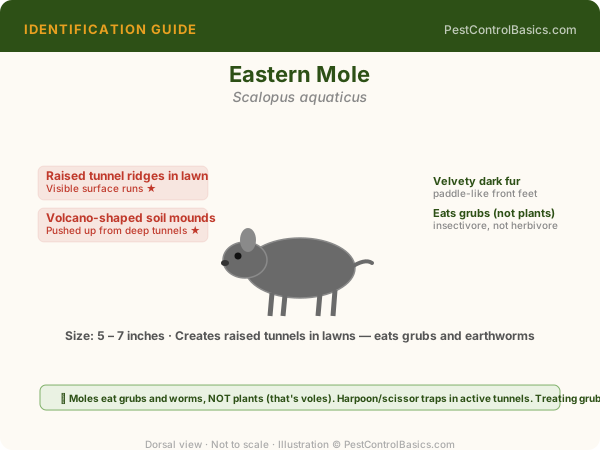
Original illustration by PestControlBasics.com. Use anatomical labels above to confirm your identification.
🔍 Identification Photo
Use this photo to confirm your identification. Click to enlarge. Correct ID is the essential first step to effective treatment.
Eastern mole (Scalopus aquaticus) — paddle-like front feet, velvety gray fur, pointed snout, vestigial eyes; creates raised surface feeding tunnels
📷 Wikipedia / Wikimedia Commons / CC BY-SA⚠️ Photo loaded live from Wikipedia/Wikimedia Commons (CC BY-SA). Appearance varies by region, age, and sex. When uncertain, contact a licensed pest professional.
What moles actually eat — and why it matters
The most persistent mole myth: that they eat garden bulbs and plant roots. They don't. Moles are insectivores — their diet is almost entirely earthworms, supplemented with beetle grubs and other soil invertebrates. Their saliva contains a toxin that paralyzes earthworms, allowing moles to store live worms in underground "larders."
If your tulip bulbs are disappearing, your garden plants are dying from root damage, or you're seeing surface runways through the lawn — that's voles, not moles. Treating for moles when you have voles is a complete waste of time and money.
Why healthy lawns attract moles: A well-maintained, well-irrigated lawn with good organic matter has an excellent earthworm population. More earthworms = more moles. Moles are actually a sign of good soil biology, which is cold comfort when your lawn looks like a battlefield.
Feeding tunnels vs. main tunnels: The fresh raised ridges you see appearing after rain are shallow feeding tunnels — used once or twice to hunt earthworms near the surface. Main travel tunnels are deeper and reused daily. Trapping in feeding tunnels is largely ineffective. Find and trap main tunnels.
Finding main tunnels and setting the trap correctly
Finding main tunnels: Press down a section of each raised ridge firmly with your foot. Check back in 24 hours. Sections that re-raise are active main tunnels — the mole is clearing the blockage daily. Sections that stay flat are abandoned. Focus all trap effort on re-raised sections.
Macabee placement: Dig into the tunnel just enough to set the trap inside it — the trigger plates sit in the tunnel floor. Set two traps back-to-back facing in opposite directions (the mole approaches from either direction). Cover the opening with soil and a board to block light — moles avoid light and will push through to clear their tunnel, triggering the trap.
Check every 24 hours: Macabee traps are designed to catch and hold — the mole won't decompose the way it would in a snap trap, but daily checking is still best practice.
Grub control: Apply imidacloprid (Scott's GrubEx or similar) in May–June to reduce white grub populations. This reduces the mole food supply and makes the property less attractive after trapping eliminates the current population. It won't solve an active mole problem but reduces re-infestation pressure long-term.
Castor oil-based repellents (Mole-Max, Repellex) create an olfactory deterrent that causes moles to relocate — to adjacent untreated areas. They return when the treatment degrades. Repellents are useful for protecting specific high-value areas temporarily, not for eliminating mole populations.