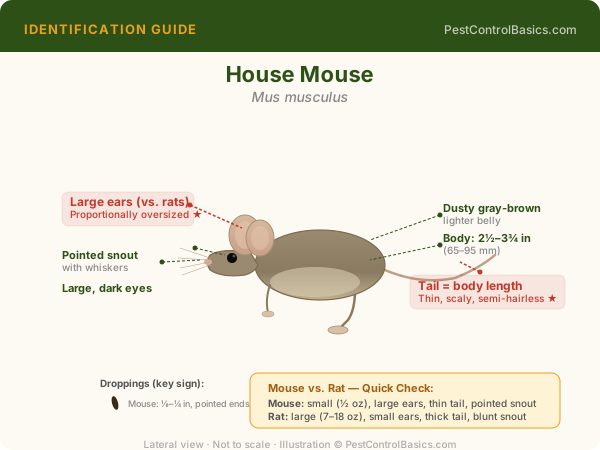
Original illustration by PestControlBasics.com. Use anatomical labels above to confirm your identification. For photo references, see the identification section below.
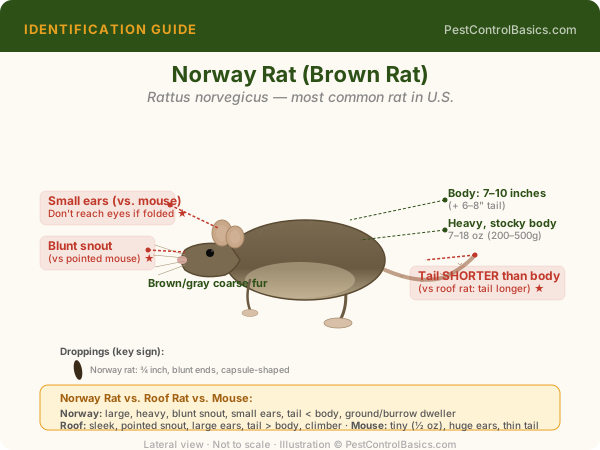
Original illustration by PestControlBasics.com. Use anatomical labels above to confirm your identification.
🔍 Identification Photo
Use this photo to confirm your identification. Click to enlarge.
Common rodent pests — Norway rat, roof rat, house mouse, and deer mouse are the four primary structural and health pest rodents in North America
📷 Wikipedia / Wikimedia Commons / CC BY-SA⚠️ Photo loaded live from Wikipedia/Wikimedia Commons (CC BY-SA).
⚠️ Photos loaded from Wikipedia/Wikimedia Commons. Appearance varies by region, age, and sex.
Confirm you have rodents — and which species
Rodents are nocturnal and secretive. By the time most people see one, there are already dozens behind the walls. These are the definitive signs to check for immediately.
Droppings — The #1 Confirmation
Fresh droppings are dark and moist. Old droppings are gray and crumble when touched. Mouse droppings: 1/8 to 1/4 inch, rod-shaped, pointed ends — like a small dark grain of rice. Rat droppings: 1/2 to 3/4 inch, blunt ends — like a dark olive pit. Find droppings along walls, in cabinet corners, under sinks, in pantries, and near any food storage.
Gnaw Marks
Rodents gnaw constantly — their incisors grow continuously and must be worn down. Look for gnawed food packaging, gnawed wood along baseboards and cabinet corners, and gnawed electrical wires. Chewed wiring is a serious fire hazard — any wire damage requires an electrician's inspection.
Runways and Grease Marks
Rats follow the same paths repeatedly, leaving dark grease marks along walls from their oily fur. You'll see dark smudges along baseboards, in gaps under pipes, and at entry points. Mice leave similar but fainter marks. Placing white tissue paper along suspected runways and checking for footprints or grease transfer confirms active travel routes.
Hantavirus is carried in mouse droppings, urine, and nesting materials — and becomes airborne when disturbed. Never sweep or vacuum rodent droppings dry. Always: wear gloves and N95 mask, spray droppings with a 1:10 bleach solution and let sit 5 minutes before wiping up with a damp paper towel. Double-bag all waste. Ventilate the area before working in it.
Seal the building. This ends the problem forever.
You can trap mice indefinitely — and new ones will continue entering. Exclusion — physically sealing every entry point — is the only treatment that permanently ends a rodent problem. It is also completely DIY-able and inexpensive. A thorough exclusion job costs $50–$200 in materials and a few hours of work.
The rule: mice can enter through any gap 1/4 inch or larger. Rats can enter through any gap 1/2 inch or larger. A mouse can collapse its skull and compress its body to fit through a gap the diameter of a ballpoint pen. If you can see daylight through a gap, a mouse can use it.
Steel wool + Great Stuff foam: Pack steel wool in the gap first, then spray foam over it. Steel wool prevents chewing through foam. Hardware cloth (1/4 inch galvanized mesh): For larger openings like crawlspace vents, eave gaps, and foundation openings. Fasten with screws, not staples. Metal door sweeps with steel reinforcement: Standard rubber sweeps are not rodent-proof. Copper mesh: An alternative to steel wool — doesn't rust and packs more easily into irregular gaps.
Trap placement is everything
Rodents travel along walls with their whiskers touching the surface — they rarely cross open spaces. Place traps touching the wall, perpendicular to it with the trigger end facing the wall. This is the most important placement rule most homeowners get wrong.
What to buy and how to use it
After exclusion — make it permanent
Food Storage
All dry goods in rodent-accessible areas (pantries, garages, basements) should be stored in sealed hard plastic or glass containers. Cardboard boxes and paper bags offer no barrier. Pet food is the #1 food source for residential rodents — store in a sealed bin and do not leave out overnight.
Outdoor Habitat Reduction
Dense groundcover, wood piles, and debris piles within 20 feet of the structure provide nesting habitat and approach corridors. Maintain an 18-inch clear zone of gravel or bare soil around the foundation perimeter. This makes approach visible to predators and removes cover that mice use to reach your foundation walls.
Annual Inspection
Walk the full exterior perimeter every fall before temperatures drop — that's when rodents actively seek winter shelter. Re-inspect and re-seal any gaps that have opened due to settling, weathering, or damage. Check door sweeps for wear. An hour of inspection each fall prevents an entire winter of infestation.
Snap Traps Year-Round
Professional pest control companies often recommend leaving 2–4 snap traps permanently set in low-traffic areas (garage, basement, attic) even after eliminating an active infestation. They serve as monitoring devices — if you catch something, you have a new entry point to find.
🐰 New: Complete Rodent Control Hub — all species, exclusion guide, hantavirus safety, and trapping protocols in one place.