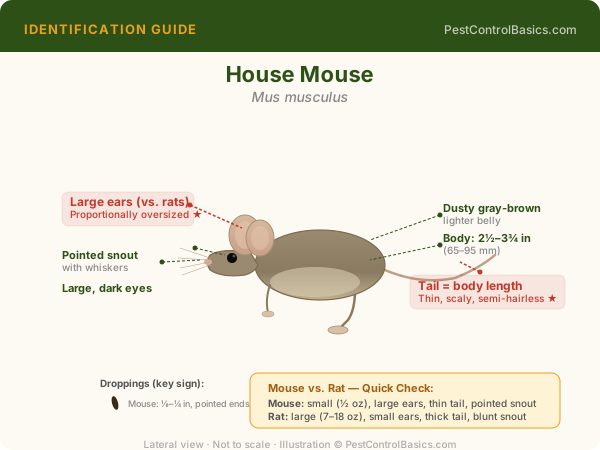
Original illustration by PestControlBasics.com. Use anatomical labels above to confirm your identification. For photo references, see the identification section below.
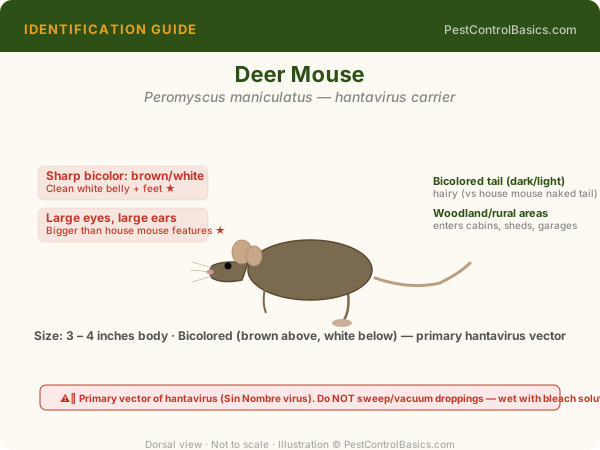
Original illustration by PestControlBasics.com. Use anatomical labels above to confirm your identification.
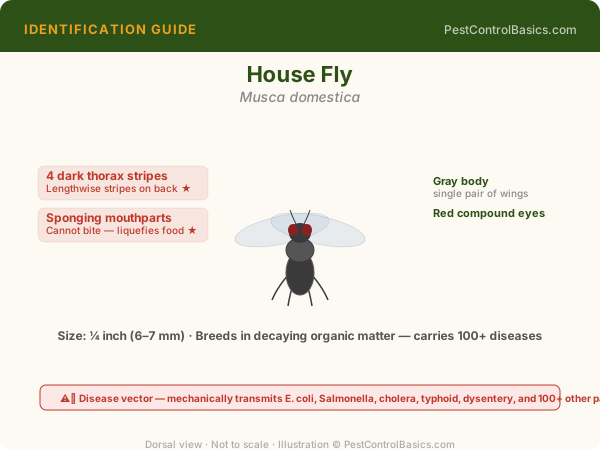
Original illustration by PestControlBasics.com. Use anatomical labels above to confirm your identification.
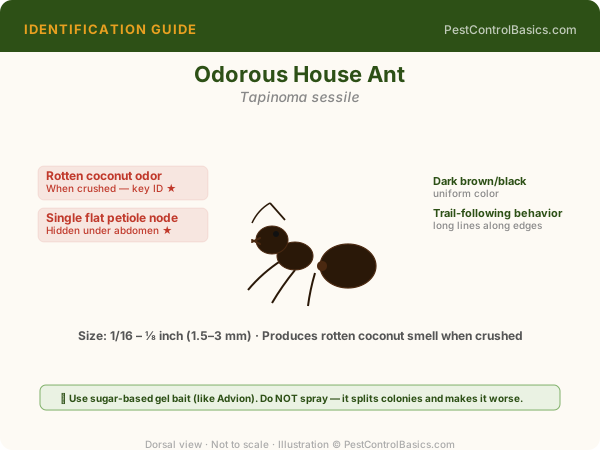
Original illustration by PestControlBasics.com. Use anatomical labels above to confirm your identification.
🔍 Identification Photo
Use this photo to confirm your identification. Click to enlarge. Correct ID is the essential first step to effective treatment.
House mouse (Mus musculus) — uniform dusty gray-brown; pointed snout; large ears relative to head; tail equal to body length; 50–80 droppings per night
📷 Wikipedia / Wikimedia Commons / CC BY-SA⚠️ Photo loaded live from Wikipedia/Wikimedia Commons (CC BY-SA). Appearance varies by region, age, and sex. When uncertain, contact a licensed pest professional.
The single most common DIY mistake
The most common reason mouse control fails: too few traps. Two snap traps in a kitchen drawer is not a mouse strategy. House mice have a home range of 10–30 feet, travel multiple routes, and a single female produces up to 60 young per year. You need enough traps to intercept the entire active population simultaneously.
The 12-trap rule: Place a minimum of 12 snap traps throughout all active areas in a single session — one every 2–3 feet along every active wall. In a kitchen: inside every lower cabinet back corner, under the stove, under the refrigerator, along the pantry walls, and behind the washer/dryer if in the kitchen area.
Placement beats bait: Set traps perpendicular to the wall, trigger end facing the baseboard. Mice running along walls trigger the trap with their body before they even find the bait.
Check every 24 hours: A dead mouse left in a trap decomposes and deters others. Reset immediately after each catch.
The permanent fix — no gap left unsealed
Trapping eliminates current residents. Exclusion prevents new ones. A house mouse can compress its skull to fit through any gap 1/4 inch or larger — roughly the diameter of a pencil.
Priority entry points: Foundation-sill interface (the joint where wood framing meets concrete), gaps around all utility pipes and conduits, garage door weatherstripping, and any exterior door with a visible gap when closed.
Materials that work: Xcluder rodent-proof stainless mesh packed tightly into gaps, followed by Great Stuff PestBlock foam over the top. Rodents cannot chew through Xcluder. Foam alone will be chewed through — always use mesh first.
Verification: After 5–7 days with no catches and no new droppings, lay a thin strip of flour along suspected runways. No footprints in 48 hours confirms the problem is resolved.
Rodent urine fluoresces bright blue-white under UV blacklight. Shine a UV flashlight along all walls, under appliances, and across the basement floor. Urine trails reveal exactly where mice are traveling — and lead directly to their entry points.