HomePest LibraryNorway Rat
Disease Vector — Requires Action
🐰

Norway Rat

Rattus norvegicus — Common Rat / Sewer Rat / Brown Rat

The largest common commensal rat — heavy-bodied, burrowing, and highly suspicious of anything new. Understanding neophobia is the key to trapping success. Without pre-baiting, most traps fail. With proper technique, Norway rats are very controllable.

Body length7–10 inches + tail
WeightUp to 1 lb
Neophobic?Yes — avoids new objects 3–7 days
Entry gap1/2 inch
Disease riskLeptospirosis, salmonella, hantavirus
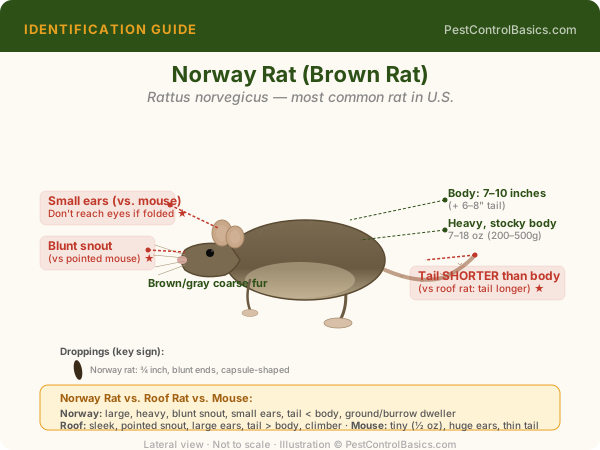
📐 FIELD GUIDE ILLUSTRATION
Norway rat (Rattus norvegicus) identification illustration with labeled anatomical features — PestControlBasics.com

Original illustration by PestControlBasics.com. Use anatomical labels above to confirm your identification.

🔍 Identification Photo

Use this photo to confirm your identification. Click to enlarge. Correct ID is the essential first step to effective treatment.

Norway rat (Rattus norvegicus) — stocky, blunt snout, small ears; tail SHORTER than body+head; burrows at ground level n

Norway rat (Rattus norvegicus) — stocky, blunt snout, small ears; tail SHORTER than body+head; burrows at ground level near foundations

📷 Wikipedia / Wikimedia Commons / CC BY-SA

⚠️ Photo loaded live from Wikipedia/Wikimedia Commons (CC BY-SA). Appearance varies by region, age, and sex. When uncertain, contact a licensed pest professional.

Identification

Norway rat vs. roof rat — critical differences

Identifying which rat species you have determines where to set traps and how to approach exclusion. The two most common U.S. rats are Norway rats and roof rats — they rarely overlap in the same building.

Norway rat features: Heavy, stocky body. Blunt muzzle. Ears are small and lay close to the head. Tail is thick and shorter than the body. Found at ground level — burrows, sewers, under concrete slabs.

Droppings: Norway rat droppings are large (3/4 inch), capsule-shaped with blunt ends. Finding large blunt droppings at ground level confirms Norway rats. Smaller droppings with pointed ends = roof rats.

Burrow identification: Active Norway rat burrows have fresh, loose soil outside the entrance, no debris inside, and no cobwebs over the opening. Inactive burrows will have debris, spider webs, and settled soil.

Neophobia & Trapping

Why Norway rats avoid new traps — and how to overcome it

Norway rats are among the most cautious animals in the world when it comes to new objects in their territory. This trait — neophobia — evolved over thousands of years as a survival mechanism in environments where humans tried to poison or trap them.

The consequence: A snap trap placed in an active runway will often sit untouched for a week. The rat detects something new and avoids it. Most DIY rodent control fails because people place traps and check back to find them untouched — concluding traps don't work. The traps are fine — the pre-baiting step was skipped.

Pre-baiting protocol: Place unset traps in active areas for 3–5 consecutive days with attractive bait (bacon, peanut butter, or chocolate). Allow rats to feed freely from the unset traps. Once they are feeding consistently — trigger the trap and set all locations simultaneously on the same night. Catch rates with pre-baiting are typically 3–5× higher than without.

💡 Set Everything on the Same Night

After pre-baiting, set all traps in all active locations on the same evening. Rats that escape one encounter become exponentially harder to catch — they associate the trap with danger. Maximum simultaneous pressure is the strategy.

Exclusion

The permanent solution — closing every entry

Trapping without exclusion is temporary. Norway rats can squeeze through any gap 1/2 inch or larger. Entry points are typically at ground level: gaps around utility pipes, foundation-sill interface, crawlspace vents, and gaps under exterior doors.

Use Xcluder rodent-proof mesh (stainless steel fill fabric that rats cannot chew through) packed into gaps, followed by Great Stuff PestBlock foam over the top. For larger openings, use 1/4-inch hardware cloth secured with screws.

Also remove attractants: secure all garbage in rat-proof metal cans with lids, eliminate pet food left outdoors overnight, remove fallen fruit, and clear wood piles and debris that provide harborage adjacent to the structure.

⚠ Hantavirus Cleanup Protocol

Before cleaning any rat droppings, review the full hantavirus safety protocol. Spray all droppings with 1:10 bleach solution, wait 5 minutes, wipe up wet (never sweep dry). N95 respirator required. Read the full guide →

Quick Reference
Size7–10 inches body; tail shorter
NoseBlunt, heavy muzzle
EarsSmall, close to head
TailThick, shorter than body
ColorBrown-gray above, lighter below
Droppings3/4 inch, capsule, blunt ends
HabitatGround level, burrows, sewers
Neophobic?Yes — pre-bait before setting
Not sure? AI Bug ID → Find a Pro →
📚 Sources: CDC Rodent Control · EPA Rodenticide Safety
Published: Jan 1, 2025 · Updated: Apr 7, 2026
Norway Rat
Norway Rat

Frequently Asked Questions

How do I know if I have Norway Rat?

Signs of Norway Rat include physical sightings, droppings or frass, damage to food or materials, and unusual odors. Inspect hidden areas like wall voids, behind appliances, and in storage spaces. A flashlight inspection after dark is often most revealing.

Are Norway Rat dangerous to humans or pets?

Norway Rat can pose health risks including bites, allergic reactions, food contamination, and disease transmission. Children, elderly, and pets are especially vulnerable. Consult a pest management professional when an infestation is confirmed.

Can I eliminate Norway Rat myself?

Light infestations may be manageable with DIY baits, traps, and targeted treatments. Established infestations typically require professional intervention. Misapplied products often scatter pests and worsen the problem long-term.

How long does Norway Rat treatment take?

Timelines vary by infestation size and method. Baits may take 1–4 weeks to work through a colony. Chemical treatments often require 2–3 applications spaced 2–4 weeks apart. Monitor for 30–60 days after treatment to confirm elimination.

What attracts Norway Rat to my home?

Norway Rat are typically drawn by food sources, standing moisture, warmth, and shelter. Sealing entry points, reducing clutter, fixing leaks, and storing food in airtight containers are the most effective long-term prevention measures.

Related Resources

📚 Full Pest Library🧪 DIY vs. Pro Quiz💰 Cost Guide🌿 IPM Guide🔍 Find a Pro
🧪 Recommended Treatment Products
Rodenticide Comparison Bromethalin Zinc Phosphide IPM Guide
Full product guides with mixing rates and safety info. → Browse All 130 Pesticide Guides
🔗 Related Pests
Roof Rat Muskrat
Compare similar pests to confirm your identification. → Use our ID Flowchart
🔮
Reviewed by Derek GiordanoContent on PestControlBasics.com is developed with input from certified pest management professionals and cross-referenced against EPA, CDC, and university extension guidance. Last reviewed: April 2026.

🗺️ US Distribution — Norway Rat

image/svg+xml
Common Occasional Not Present
States Present
51
Occasional
0
Primary Region
All 50 states (indoor pest)
📊 Source: University extension services, USDA, CDC vector data, and published entomological surveys.