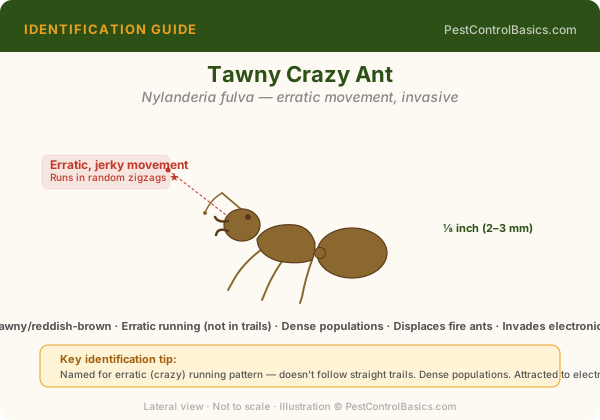
Original illustration by PestControlBasics.com. Use anatomical labels above to confirm your identification.
🔍 Identification
1.5-2mm; reddish-brown; long legs; very long antennae; erratic fast running pattern (hence 'crazy ant'). Found in massive supercolonies — billions of individuals per acre in high-density areas. No defined trails — workers run erratically in all directions. Attracted to electronics: nest inside circuit boxes, cars, AC units, phones. Found in Florida, Texas, Louisiana, Georgia, Mississippi, and spreading.
🧬 Biology & Behavior
Supercolonies have no clear queen structure — hundreds of queens per colony. Reproductively unique: females mate and establish new colonies by simple budding, producing explosive population growth. They displace fire ants by mobbing them and applying formic acid. In heavy infestations, they cover the ground in a moving carpet of ants. Attracted to electrical equipment by some unknown mechanism — they accumulate in junction boxes and short-circuit equipment.
⚠️ Damage & Health Risk
Displacement of native ant communities and fire ants; livestock deaths from asphyxiation (ants enter nostrils); destruction of electrical equipment; structural infestation; agricultural losses.
🔧 DIY Treatment
Perimeter bifenthrin spray provides temporary suppression but not elimination. Fipronil (Termidor SC) has shown better results for perimeter defense. For electronics: seal all electrical entry points with weather stripping. Talstar XTRA (with zeta-cypermethrin + bifenthrin) has shown results. No treatment provides complete elimination of established supercolonies.
👷 When to Call a Pro
In heavily infested commercial or agricultural settings, licensed PCO with fipronil-based barrier treatment provides the best available suppression.