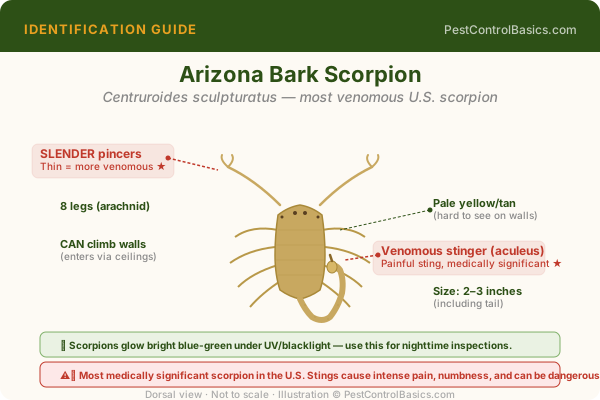
Original illustration by PestControlBasics.com. Use anatomical labels above to confirm your identification.
🔍 Identification Photo
Use this photo to confirm your identification. Click to enlarge.
Scorpion — venomous stinger at tail tip, large pincers, 4 pairs of legs; ALL scorpions fluoresce bright green under UV light at night
📷 Wikipedia / Wikimedia Commons / CC BY-SA⚠️ Photo loaded live from Wikipedia/Wikimedia Commons (CC BY-SA).
⚠️ Photos loaded from Wikipedia/Wikimedia Commons. Appearance varies by region, age, and sex.
Know your scorpion — most are harmless
Of the 90+ scorpion species in the U.S., only the Bark Scorpion is medically significant. Most scorpion stings cause local pain comparable to a bee sting and resolve within hours. The bark scorpion is the critical exception.
Find every scorpion in and around your home tonight
Scorpions produce hyaline in their exoskeleton that fluoresces intensely under UV (365nm) light. This makes nighttime scorpion hunting — called "blacklight hunting" — the single most effective assessment tool available to homeowners.
One hour with a good UV flashlight after dark reveals every scorpion on your property: inside closets, behind furniture, under rocks and bark outside, on walls, in the garage. It lets you see exactly where they're entering, where they're harboring, and how serious your infestation actually is.
This technique also works through windows — scan the exterior of your home from inside with a UV light to spot scorpions on the wall outside before opening the door. Use before reaching into woodpiles, under outdoor furniture, or into dark storage areas.
Seal every gap 1/16 inch or larger
Bark scorpions can compress their body to fit through gaps as small as 1/16 inch — the thickness of a credit card. This makes complete exclusion challenging but achievable with attention to detail. Start with the UV assessment to know where they're entering, then systematically seal every gap.
Priority Exclusion Points
Weatherstripping: Replace all door weatherstripping and install door sweeps. Bark scorpions regularly enter under doors. Window frames: Caulk all gaps around window frames. Utility penetrations: Seal every pipe, cable, and conduit entry with foam and steel wool. Roof line: Bark scorpions climb — seal all soffit and fascia gaps, attic vents with fine mesh. Evaporative cooler openings: Very common entry point in Arizona — install tight-fitting covers when not in use.
Place glue boards along baseboards in every room and in the garage before treating chemically. After 48–72 hours, the distribution of catches tells you exactly which rooms have activity and where scorpions are traveling. This eliminates guesswork from treatment placement and shows whether exclusion gaps have been successfully sealed after repairs.
What works — and what the pros use
Chemical treatment for scorpions focuses on reducing their food supply (other insects) and applying residuals where scorpions travel. Scorpions are partially resistant to contact insecticides — their exoskeleton limits absorption — so desiccant dusts and broad insect control matter as much as direct scorpion treatment.
Any bark scorpion sting in a child under 6 requires immediate emergency care — do not wait to see if symptoms develop. In adults: seek care if symptoms spread beyond the sting site, if you experience difficulty swallowing, muscle twitching, blurred vision, or breathing changes. Arizona Poison Control: 1-800-222-1222 (available 24/7). Antivenom (Anascorp) is available at most Arizona hospitals and dramatically speeds recovery.