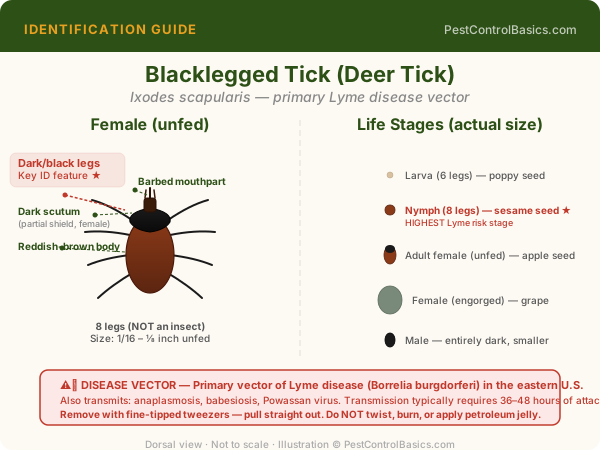
Original illustration by PestControlBasics.com. Use anatomical labels above to confirm your identification.
🔍 Identification Photo
Use this photo to confirm your identification. Click to enlarge.
Blacklegged tick (Ixodes scapularis) — MUCH smaller than dog ticks; nymph (poppy-seed size) spreads most Lyme disease; check thoroughly after every outing
📷 Wikipedia / Wikimedia Commons / CC BY-SA⚠️ Photo loaded live from Wikipedia/Wikimedia Commons (CC BY-SA).
⚠️ Photos loaded from Wikipedia/Wikimedia Commons. Appearance varies by region, age, and sex.
Four ticks you need to know — very different disease risks
What ticks actually transmit — and how serious each is
| Disease | Tick Vector | Region | U.S. Cases/Year | Severity |
|---|---|---|---|---|
| Lyme Disease | Black-legged tick | Northeast, Midwest | 476,000+ | High — chronic if untreated |
| Rocky Mountain Spotted Fever | American dog tick | Southeast, Mid-Atlantic | ~6,000 | Extreme — 20% fatal if untreated |
| Anaplasmosis | Black-legged tick | Northeast, upper Midwest | ~5,000 | Moderate — responds to doxycycline |
| Ehrlichiosis | Lone star tick | Southeast, South-Central | ~2,000 | Moderate — responds to doxycycline |
| Alpha-Gal Syndrome | Lone star tick | Southeast, expanding | ~450,000 est. | Lifelong red meat allergy |
| Babesiosis | Black-legged tick | Northeast coastal | ~3,000 | High — severe in elderly/immunocomp. |
| Powassan Virus | Black-legged tick | Northeast, Great Lakes | ~25/year | Rare but 10% fatal — no treatment |
| Tularemia | Dog tick, wood tick | Central U.S. | ~200 | High — responds to antibiotics |
The classic "bullseye" rash (erythema migrans) appears in 70–80% of Lyme cases — an expanding red ring with central clearing, 2 inches or larger. It appears 3–30 days after a bite. If you see this rash — with or without a known tick bite — seek immediate medical attention. Early Lyme responds well to doxycycline. Late-stage Lyme can cause chronic arthritis, neurological damage, and cardiac complications that are much harder to treat.
How to remove a tick safely — and what not to do
Do not use petroleum jelly, nail polish, or heat (lighter, match) to "force" the tick out. These methods cause the tick to release more saliva — potentially increasing disease transmission risk. Do not twist or jerk — breaks mouthparts off in skin. Do not crush the tick with bare fingers. Do not flush down the drain — this doesn't kill ticks.
The layered defense that actually works
Permethrin-Treated Clothing — Most Effective
Treating outdoor clothing and gear with permethrin is the single most effective personal tick protection measure. Permethrin bonds to fabric fibers and survives 6+ wash cycles. It kills ticks on contact — they don't need to bite through the fabric. Apply to boots, pants, socks, and shirts. Kills ticks within seconds of contact. Safe when dry — never apply to skin.
DEET or Picaridin on Skin
Apply 25–30% DEET or 20% Picaridin to exposed skin areas not covered by permethrin-treated clothing. Repels but does not kill ticks. CDC-recommended. Both effective for 5–8 hours.
Daily Full-Body Tick Checks
Check entire body within 2 hours of outdoor activity. Priority areas: scalp, ears, underarms, groin, behind knees, between toes. Use a mirror or have someone check your back and scalp. Shower within 2 hours of coming indoors — this helps wash off unattached ticks and makes checking easier.
Yard Treatment
Bifenthrin or permethrin yard spray applied along the lawn edge where it meets woodland or tall grass reduces tick populations by 68–100% in studies. Focus treatment on the transition zone — ticks questing (waiting for hosts) primarily in this 9-foot border zone, not in the middle of a maintained lawn. Apply spring and late summer for maximum coverage.