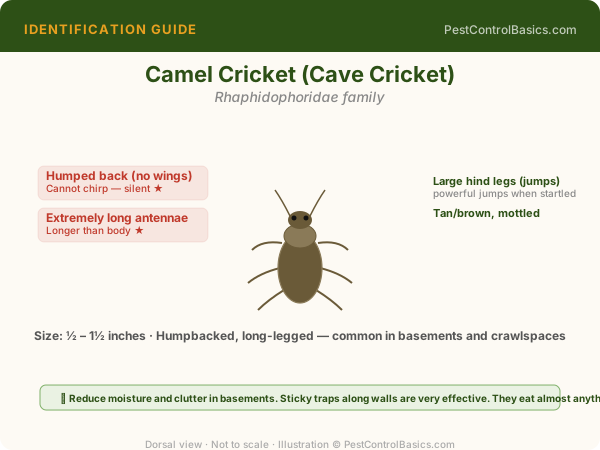
Original illustration by PestControlBasics.com. Use anatomical labels above to confirm your identification.
🔍 Identification
Camel crickets (also called cave crickets or spider crickets) are immediately recognizable:
- Humpbacked, arched posture — looks like a tiny camel's hump
- Very long, spindly legs extending well beyond the body
- Long antennae, sometimes 2-3× body length
- Wingless — cannot fly or chirp
- Light tan to dark brown; 12-25mm body length
The introduced Asian species (Diestrammena asynchrona) is now the most common species found in US homes, particularly in the Northeast.
🧬 Biology & Behavior
Camel crickets are cave-adapted — they require cool, dark, humid environments. They're detritivores (feed on decaying organic matter) and don't damage structures or food. They can chew fabric if it's soiled or if large numbers are present, but fabric damage is uncommon.
Their 'jump toward you' behavior is a defensive adaptation from cave environments — a predator encounters a jumping object in the dark and retreats. It's not aggression; they have no means of biting or stinging.
⚠️ Damage & Health Risk
No biting, stinging, or disease transmission. Potential minor fabric damage in severe infestations. Primary impact: psychological — large numbers in basements are deeply disturbing to many people.
🔧 DIY Treatment
Address the moisture: Camel crickets require high humidity. Dehumidifiers, crawl space encapsulation, and fixing moisture intrusion are the most effective long-term solutions.
Exclusion: Seal crawl space vents, gaps under doors, and foundation cracks.
Perimeter treatment: Apply bifenthrin or lambda-cyhalothrin around the exterior foundation and in crawl spaces. Sticky traps placed along basement walls catch large numbers.
Reduce harborage: Remove debris, boxes, and clutter from basements and crawl spaces.
👷 When to Call a Pro
Rarely necessary for camel crickets alone. If large numbers persist after moisture and exclusion work, a one-time professional perimeter treatment is effective.