📐 FIELD GUIDE ILLUSTRATION
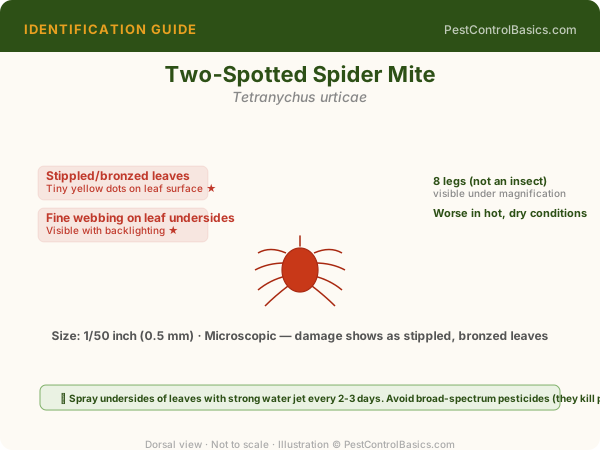
Original illustration by PestControlBasics.com. Use anatomical labels above to confirm your identification.
📋 Steps
1
Confirm spider mites with the paper test
Hold a piece of white paper under suspect leaves and tap sharply. Tiny specks that move on the paper = spider mites. Inspect the paper with magnification — oval, 8-legged creatures. Also look for fine webbing on leaf undersides and bronzed, stippled leaf coloring.
2
Start with a forceful water spray
High-pressure water spray on leaf undersides removes 80% of spider mites mechanically. Use the strongest spray your plant can tolerate. Do this every 2 days for 2 weeks for moderate infestations. This is more effective as an initial step than immediately applying chemicals.
3
Apply insecticidal soap for live colonies
2-3% insecticidal soap (Safer Brand) applied thoroughly to leaf undersides — every 5 days for 4 applications. Soap kills on contact but has no residual. Complete coverage of leaf undersides is critical — mites hide where spray doesn't reach.
4
Apply neem oil (cold-pressed) for reproduction disruption
After 2-3 soap treatments: apply neem oil (2 tbsp + 1 tsp dish soap per gallon) to disrupt mite reproduction through azadirachtin. The different mode of action prevents resistance development.
5
For severe infestations: apply miticide (bifenazate or abamectin)
Consumer: Floramite (bifenazate) for ornamentals. Professional: Avid (abamectin). Both are effective on mite-resistant populations. Rotate modes of action — mites develop resistance quickly to any single product.
💡 Tips
- Spider mites thrive in hot, dry, dusty conditions — regular leaf misting and humidity above 50% prevents most spider mite problems on houseplants
- Heavily infested plants should be isolated immediately — spider mites spread between adjacent plants within days
- Predatory mites (Phytoseiulus persimilis, Neoseiulus californicus) provide biological control in greenhouses and large indoor gardens — commercially available online
- Never use broad-spectrum pyrethroids for spider mite control — they kill the natural predatory mites that provide free biological control, often making infestations worse
⚖️ Educational use only. Disclaimer →