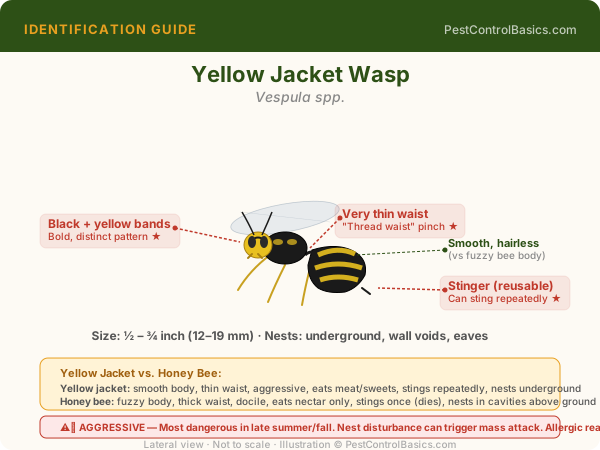
Original illustration by PestControlBasics.com. Use anatomical labels above to confirm your identification.
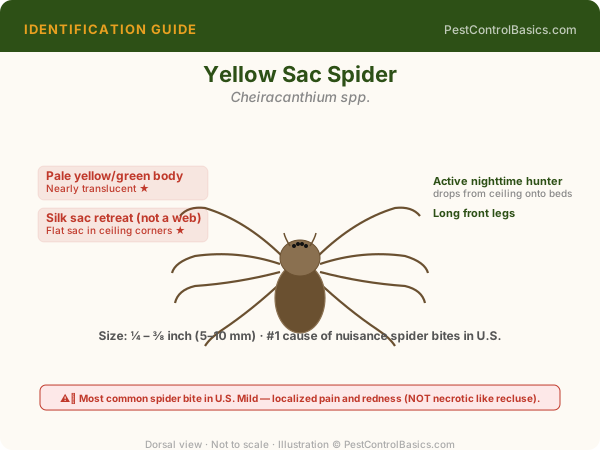
Original illustration by PestControlBasics.com. Use anatomical labels above to confirm your identification.
🔍 Identification Photo
Use this photo to confirm your identification. Click to enlarge. Correct ID is the essential first step to effective treatment.
Yellow jacket (Vespula sp.) — bright yellow-black banding; smooth (not hairy) abdomen; wings fold lengthwise at rest; aggressive colony defenders
📷 Wikipedia / Wikimedia Commons / CC BY-SA⚠️ Photo loaded live from Wikipedia/Wikimedia Commons (CC BY-SA). Appearance varies by region, age, and sex. When uncertain, contact a licensed pest professional.
Yellow jacket vs. honey bee vs. paper wasp
Yellow jackets are frequently confused with honey bees and paper wasps. Correct identification matters because the treatment approach and urgency differ significantly.
Yellow jacket vs. honey bee: Yellow jackets have a very narrow, pinched waist and are smooth and shiny — they look like they're wearing body armor. Honey bees are fuzzy with visible body hair and a less pronounced waist. Yellow jacket coloring is brighter, cleaner yellow and black. If it's fuzzy — bee. If it's smooth and shiny — yellow jacket.
Yellow jacket vs. paper wasp: Paper wasps are slender, long-legged, and build open umbrella-shaped nests under eaves. Yellow jackets are more compact and robust. Paper wasp colonies are much smaller (20–75 workers) and less aggressive. A nest with open cells visible = paper wasp. Enclosed papery nest = yellow jacket or bald-faced hornet.
Finding the nest: Watch the flight path of returning workers in the early morning. They fly directly to and from the nest. In late summer, you may see workers entering and exiting a hole in the ground (underground nest) or a gap in siding or soffits (structural void nest).
Nighttime treatment — the only safe approach
Why nighttime only: At night, all workers are inside the nest, the colony is sluggish from cooler temperatures, and the queen is present. Daytime treatment kills workers on the surface but leaves thousands inside — they boil out within seconds to attack the threat. Nighttime treatment reaches the full colony.
Equipment: A jet aerosol (Spectracide Wasp and Hornet, Raid Wasp and Hornet) that sprays 15–20 feet. Red flashlight or red cellophane over a white light (insects cannot see red light well, reducing agitation). Long pants, long sleeves, and closed shoes regardless of temperature.
Underground nest protocol: Approach slowly from upwind. Direct a 3–5 second jet stream into the nest opening. Back away immediately without turning and running (movement triggers chase response). Return in 24 hours to verify no activity before sealing the opening.
Structural void nest: Do NOT seal the entrance before treating — workers trapped inside will chew through drywall to reach the interior. Treat first, confirm zero activity, then seal.
Throat tightening, difficulty breathing, widespread hives beyond the sting site, dizziness, or loss of consciousness after a yellow jacket sting = call 911 immediately. Anaphylaxis develops within minutes and requires epinephrine. If you have a known bee/wasp allergy, always carry an EpiPen outdoors.