Moisture Indicator Structural Damage Satellite Colony Inside

Carpenter
Ant

Camponotus pennsylvanicus & related species

They don't eat wood — they tunnel through it. But here's what matters: finding carpenter ants inside your home almost always means you have a moisture problem. Fix the moisture, and you fix the ant problem at its source.

Size1/4 – 1/2 inch — largest U.S. ant
ColorBlack (East); black & red (West)
Tunnels InMoist, softened wood only
ActiveNighttime — follow trails after dark
🐛
Quick Reference Card
Carpenter Ant
SizeLargest ant in North America
WaistOne node — smooth, rounded
WingsFront wings larger than rear (vs. termite)
FrassCoarse sawdust + insect parts (not termite frass)
Nests InMoist wood — not dry wood
ActiveNighttime foragers — watch after 9pm
Root CauseMoisture problem — find it first
vs. TermiteAnts have elbowed antennae & pinched waist
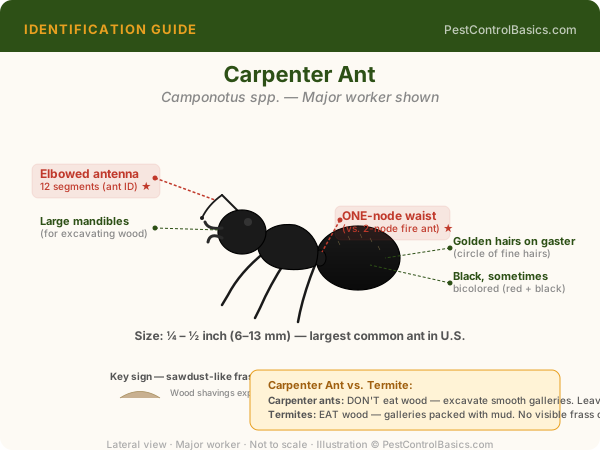
📐 FIELD GUIDE ILLUSTRATION
Carpenter ant (Camponotus spp.) identification illustration with labeled anatomical features — PestControlBasics.com

Original illustration by PestControlBasics.com. Use anatomical labels above to confirm your identification.
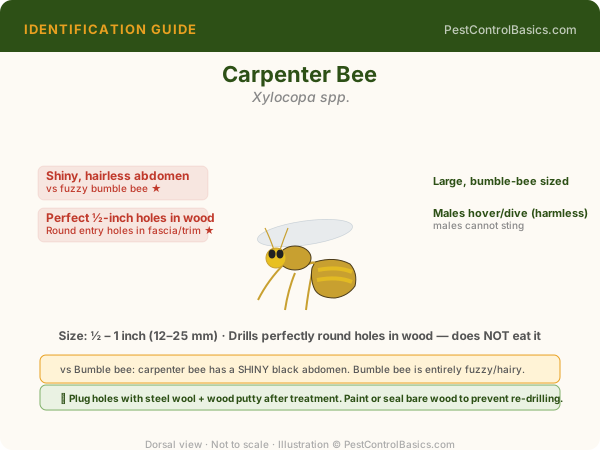
📐 FIELD GUIDE ILLUSTRATION
Carpenter Bee (Xylocopa spp.) identification illustration with labeled anatomical features — PestControlBasics.com

Original illustration by PestControlBasics.com. Use anatomical labels above to confirm your identification.

🔍 Identification Photo

Use this photo to confirm your identification. Click to enlarge.

Black carpenter ant (Camponotus pennsylvanicus) — jet black, ¼–½ inch; smooth rounded thorax; most common structural pes

Black carpenter ant (Camponotus pennsylvanicus) — jet black, ¼–½ inch; smooth rounded thorax; most common structural pest ant in North America

📷 Wikipedia / Wikimedia Commons / CC BY-SA

⚠️ Photo loaded live from Wikipedia/Wikimedia Commons (CC BY-SA).

⚠️ Photos loaded from Wikipedia/Wikimedia Commons. Appearance varies by region, age, and sex.

Biology & Key Facts

They don't eat wood — they excavate it

This is the most important distinction: carpenter ants do not consume wood for food the way termites do. They excavate galleries through moist, softened wood to create nesting space. They feed on other insects, honeydew from aphids, and food scraps — not the wood itself.

The frass (debris) they push out of galleries is a telltale sign: coarse sawdust mixed with insect body parts and soil. Termite frass (for drywood species) is fine, 6-sided pellets. Subterranean termite galleries contain no frass — the wood is hollowed out cleanly. Carpenter ant galleries are smooth-walled, almost sandpaper-smooth inside.

💡 The Moisture Insight — Most Important Thing on This Page

Carpenter ants cannot tunnel through dry, structurally sound wood. They require wood that has been softened by moisture — from roof leaks, plumbing leaks, condensation, poor drainage, or wood-to-soil contact. Finding carpenter ants inside is always a signal to investigate for a moisture source. Treat the ants without finding the moisture, and they will return. Find and fix the moisture source, and the infestation often resolves without chemical treatment.

Parent Colony vs. Satellite Colony

Carpenter ant infestations almost always involve two colonies: a parent colony located outdoors in a dead tree, stump, or log — and one or more satellite colonies inside the structure, where workers move to exploit food sources and warmer nesting conditions. The satellite colony inside your home contains workers and larvae but usually no queen. Treating only the satellite colony without finding the parent will result in continuous replenishment of the indoor population.

Identification Guide

Carpenter ant or termite? It matters enormously.

These two pests are commonly confused — and the treatment protocols are completely different. Here's how to tell them apart definitively.

Body Shape
Carpenter ant: three distinct body segments, pinched "waist" (petiole). Termite worker: thick, no pinching — looks like a soft white grain of rice.
Antennae
Carpenter ant: elbowed antennae with a distinct bend. Termite: straight antennae, no bend, bead-like segments.
Wings (if present)
Carpenter ant swarmers: front wings longer than rear. Termite swarmers: all four wings equal length and very long relative to body.
Frass / Debris
Carpenter ant: coarse sawdust mixed with insect parts — looks like shavings. Termite: fine 6-sided pellets (drywood) or no frass visible (subterranean).
Gallery Appearance
Carpenter ant galleries: smooth, clean walls running with the grain. Termite galleries: rough, packed with soil or fecal pellets, crossing the grain.
Activity Time
Carpenter ants are nocturnal foragers — you'll see them after dark following chemical trails. Termites almost never appear in the open.
Finding the Colony

Where to look — and how to track them

Follow the Foragers at Night

Carpenter ants forage primarily between 9pm and 3am. Use a red-light flashlight (ants don't see red light and won't scatter) to observe their trails after dark. Follow foragers back toward their entry point — typically a gap around a pipe, window frame, or utility penetration. The entry point leads you to the satellite colony inside.

Listen for the Colony

Large carpenter ant galleries produce a faint rustling sound inside walls — especially when disturbed. Tap along walls and listen for a hollow sound followed by increased rustling activity. Stethoscopes sold for this purpose (or a screwdriver handle pressed against the wall) can amplify the sound of ants moving inside.

Look for Moisture Hot Spots

Focus your inspection on any area with past or present moisture exposure. These are the most likely satellite colony locations:

🛀
Around Chimneys
Flashing leaks allow water to penetrate framing. Common in older homes.
Very High Risk
🛌
Below Clogged Gutters
Overflow saturates fascia boards and soffit — prime carpenter ant habitat.
High Risk
🚽
Around Skylights
Skylight seals fail over time — slow leak saturates surrounding framing.
High Risk
🚷
Under Sinks
Slow drain leaks saturate cabinet floors and wall framing over months.
High Risk
🏠
Deck & Porch Framing
Where deck ledger attaches to the house — water infiltration is common.
Very High Risk
👁
Window & Door Frames
Failed caulking allows water into the rough opening framing over years.
Moderate Risk
🔍 The Parent Colony Outside

Search your yard for the parent colony: dead tree stumps, fallen logs, firewood piles, and hollow trees within 100 yards of your home. Removing or treating the parent colony is essential for long-term control. A colony producing thousands of workers per year will continuously replenish satellite colonies indoors if the parent is left untreated.

Treatment Protocol

The correct sequence — moisture first, then bait

Step 1: Fix the moisture source. Every other step is temporary if you skip this. A carpenter ant infestation is a symptom — moisture damage is the disease. Find and repair every source of moisture intrusion before applying any treatment.

Step 2: Remove the parent colony if accessible outdoors. Treat stumps with a liquid insecticide drench. Remove firewood stacks away from the structure.

Step 3: Apply bait and residual treatment.

🍇
Bait — Reaches the Satellite Colony
Advance Carpenter Ant Bait (Abamectin)
How it works: Granule bait formulated for carpenter ants — they prefer protein-based bait over sugar (unlike most ant species). Place near foraging trails and entry points. Workers carry it back to the satellite colony and feed the larvae and other workers. Slow-acting by design — 48–72 hours before visible kill effect, which allows maximum distribution. Do not use alongside repellent sprays.
★★★★★
Best Method
💧
Void Treatment — Inside the Wall
Delta Dust (Deltamethrin) — Wall Void Application
How it works: Once you've located the satellite colony location (using the wall-tapping method or by finding frass), apply deltamethrin dust directly into the wall void through a drilled hole (5/8 inch diameter). Dust disperses through the void and kills ants on contact. Seal hole after application. This is the most direct treatment for an established indoor satellite colony. Requires knowing the location first.
★★★★Ⓒ
Very Effective
🌿
Perimeter Treatment — Outdoor Parent Colony
Bifenthrin Liquid (Talstar, Bifen IT) — Stump & Perimeter
How it works: Drench accessible parent colony locations (stumps, logs, soil around trees) with bifenthrin solution. Apply as a perimeter band around the foundation — 3 feet up the wall and 3 feet out — to intercept foragers before they enter. Replace every 4–8 weeks during ant season. This addresses the outdoor source that continues supplying workers to indoor satellite colonies.
★★★★Ⓒ
Essential Step
⚠ When to Call a Professional

If you cannot locate the satellite colony, if the colony is in a wall void you can't easily access, or if you've had carpenter ants return repeatedly over multiple years — a professional inspector with a moisture meter and borescope can find colonies that DIYers typically miss. The cost of one professional inspection is far less than ongoing structural damage from a colony that was never fully eliminated.

Prevention

Make your home unattractive to carpenter ants

Wood-to-Soil Clearance

Maintain at least 6 inches of clearance between any wood structural element and soil. This is the single most effective long-term prevention strategy. Where decks, porches, or stairs contact the ground — ensure there's concrete, gravel, or treated wood separating structural lumber from direct soil contact.

Firewood Management

Store firewood at least 20 feet from the structure and elevated off the ground on metal or concrete supports. Firewood piles are primary carpenter ant parent colony locations. Bringing infested firewood inside the house is a common way to introduce carpenter ants.

Moisture Management

Annual roof inspection, keep gutters clean, repair caulking around windows and penetrations every 3–5 years, fix any slow plumbing leaks immediately. A moisture meter used during fall inspection to check basement framing and around bathroom walls can identify developing problems before carpenter ants do.

Tree Trimming

Branches touching or overhanging the roof provide direct access bridges. Trim all branches to maintain at least 3 feet of clearance from the roof and walls. Also inspect hollow trees within 100 feet — these are common parent colony locations.

📚 Sources: Texas A&M Fire Ant Project · EPA Safe Pest Control
Published: Jan 1, 2025 · Updated: Apr 7, 2026
CarpenterAnt
CarpenterAnt

Frequently Asked Questions

How do I know if I have CarpenterAnt?

Signs of CarpenterAnt include physical sightings, droppings or frass, damage to food or materials, and unusual odors. Inspect hidden areas like wall voids, behind appliances, and in storage spaces. A flashlight inspection after dark is often most revealing.

Are CarpenterAnt dangerous to humans or pets?

CarpenterAnt can pose health risks including bites, allergic reactions, food contamination, and disease transmission. Children, elderly, and pets are especially vulnerable. Consult a pest management professional when an infestation is confirmed.

Can I eliminate CarpenterAnt myself?

Light infestations may be manageable with DIY baits, traps, and targeted treatments. Established infestations typically require professional intervention. Misapplied products often scatter pests and worsen the problem long-term.

How long does CarpenterAnt treatment take?

Timelines vary by infestation size and method. Baits may take 1–4 weeks to work through a colony. Chemical treatments often require 2–3 applications spaced 2–4 weeks apart. Monitor for 30–60 days after treatment to confirm elimination.

What attracts CarpenterAnt to my home?

CarpenterAnt are typically drawn by food sources, standing moisture, warmth, and shelter. Sealing entry points, reducing clutter, fixing leaks, and storing food in airtight containers are the most effective long-term prevention measures.

Related Resources

📚 Full Pest Library🧪 DIY vs. Pro Quiz💰 Cost Guide🌿 IPM Guide🔍 Find a Pro
🎬
Carpenter Ant vs Termite Damage
Video guide coming soon — subscribe to be notified when it's live
▶️ Subscribe on YouTube 🔍 Use ID Flowchart Instead
🧪 Recommended Treatment Products
Ant Bait Strategy Guide Fipronil (Termidor) Boric Acid Dust
Full product guides with mixing rates, safety info, and brand comparisons. → Browse All 121 Pesticide Guides
🔗 Related Pests
Powderpost Beetle Acrobat Ant Thief Ant Carpenter Bee Ghost Ant
Compare similar pests to confirm your identification. → Use our ID Flowchart
🔮
Reviewed by Derek GiordanoContent on PestControlBasics.com is developed with input from certified pest management professionals and cross-referenced against EPA, CDC, and university extension guidance. Last reviewed: April 2026.

🗺️ US Distribution — Carpenter Ants

image/svg+xml
Common Occasional Not Present
States Present
32
Occasional
6
Primary Region
Eastern United States
📊 Source: University extension services, USDA, CDC vector data, and published entomological surveys.