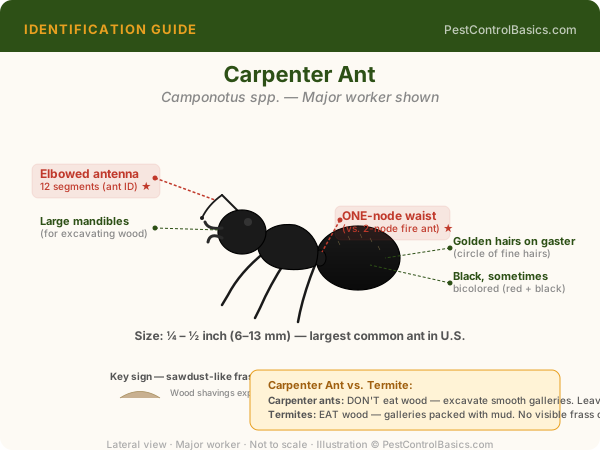
Original illustration by PestControlBasics.com. Use anatomical labels above to confirm your identification.
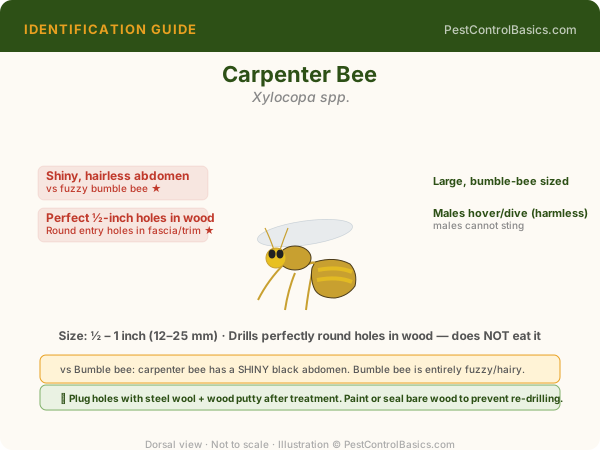
Original illustration by PestControlBasics.com. Use anatomical labels above to confirm your identification.
🔍 Identification Photo
Use this photo to confirm your identification. Click to enlarge.
Black carpenter ant (Camponotus pennsylvanicus) — jet black, ¼–½ inch; smooth rounded thorax; most common structural pest ant in North America
📷 Wikipedia / Wikimedia Commons / CC BY-SA⚠️ Photo loaded live from Wikipedia/Wikimedia Commons (CC BY-SA).
⚠️ Photos loaded from Wikipedia/Wikimedia Commons. Appearance varies by region, age, and sex.
They don't eat wood — they excavate it
This is the most important distinction: carpenter ants do not consume wood for food the way termites do. They excavate galleries through moist, softened wood to create nesting space. They feed on other insects, honeydew from aphids, and food scraps — not the wood itself.
The frass (debris) they push out of galleries is a telltale sign: coarse sawdust mixed with insect body parts and soil. Termite frass (for drywood species) is fine, 6-sided pellets. Subterranean termite galleries contain no frass — the wood is hollowed out cleanly. Carpenter ant galleries are smooth-walled, almost sandpaper-smooth inside.
Carpenter ants cannot tunnel through dry, structurally sound wood. They require wood that has been softened by moisture — from roof leaks, plumbing leaks, condensation, poor drainage, or wood-to-soil contact. Finding carpenter ants inside is always a signal to investigate for a moisture source. Treat the ants without finding the moisture, and they will return. Find and fix the moisture source, and the infestation often resolves without chemical treatment.
Parent Colony vs. Satellite Colony
Carpenter ant infestations almost always involve two colonies: a parent colony located outdoors in a dead tree, stump, or log — and one or more satellite colonies inside the structure, where workers move to exploit food sources and warmer nesting conditions. The satellite colony inside your home contains workers and larvae but usually no queen. Treating only the satellite colony without finding the parent will result in continuous replenishment of the indoor population.
Carpenter ant or termite? It matters enormously.
These two pests are commonly confused — and the treatment protocols are completely different. Here's how to tell them apart definitively.
Where to look — and how to track them
Follow the Foragers at Night
Carpenter ants forage primarily between 9pm and 3am. Use a red-light flashlight (ants don't see red light and won't scatter) to observe their trails after dark. Follow foragers back toward their entry point — typically a gap around a pipe, window frame, or utility penetration. The entry point leads you to the satellite colony inside.
Listen for the Colony
Large carpenter ant galleries produce a faint rustling sound inside walls — especially when disturbed. Tap along walls and listen for a hollow sound followed by increased rustling activity. Stethoscopes sold for this purpose (or a screwdriver handle pressed against the wall) can amplify the sound of ants moving inside.
Look for Moisture Hot Spots
Focus your inspection on any area with past or present moisture exposure. These are the most likely satellite colony locations:
Search your yard for the parent colony: dead tree stumps, fallen logs, firewood piles, and hollow trees within 100 yards of your home. Removing or treating the parent colony is essential for long-term control. A colony producing thousands of workers per year will continuously replenish satellite colonies indoors if the parent is left untreated.
The correct sequence — moisture first, then bait
Step 1: Fix the moisture source. Every other step is temporary if you skip this. A carpenter ant infestation is a symptom — moisture damage is the disease. Find and repair every source of moisture intrusion before applying any treatment.
Step 2: Remove the parent colony if accessible outdoors. Treat stumps with a liquid insecticide drench. Remove firewood stacks away from the structure.
Step 3: Apply bait and residual treatment.
If you cannot locate the satellite colony, if the colony is in a wall void you can't easily access, or if you've had carpenter ants return repeatedly over multiple years — a professional inspector with a moisture meter and borescope can find colonies that DIYers typically miss. The cost of one professional inspection is far less than ongoing structural damage from a colony that was never fully eliminated.
Make your home unattractive to carpenter ants
Wood-to-Soil Clearance
Maintain at least 6 inches of clearance between any wood structural element and soil. This is the single most effective long-term prevention strategy. Where decks, porches, or stairs contact the ground — ensure there's concrete, gravel, or treated wood separating structural lumber from direct soil contact.
Firewood Management
Store firewood at least 20 feet from the structure and elevated off the ground on metal or concrete supports. Firewood piles are primary carpenter ant parent colony locations. Bringing infested firewood inside the house is a common way to introduce carpenter ants.
Moisture Management
Annual roof inspection, keep gutters clean, repair caulking around windows and penetrations every 3–5 years, fix any slow plumbing leaks immediately. A moisture meter used during fall inspection to check basement framing and around bathroom walls can identify developing problems before carpenter ants do.
Tree Trimming
Branches touching or overhanging the roof provide direct access bridges. Trim all branches to maintain at least 3 feet of clearance from the roof and walls. Also inspect hollow trees within 100 feet — these are common parent colony locations.